How to Use an Incense Seal (香篆): Powder, Ash Bed and Stencil
An incense seal is a continuous trail of loose incense powder pressed into a pattern on a levelled bed of ash, then lit at one end. You need four things: a shallow tray, fine ash, a brass stencil, and powder fine enough to hold its shape. Level the ash, place the stencil, fill the pattern, lift straight up, light one end.
It is the slowest way to burn incense and the most rewarding to watch: the ember travels the whole pattern in one unbroken line, and the trail is usually shaped like a character from seal script — which is what 篆 (zhuàn) means.
What is an incense seal (香篆)?
香篆 (xiāng zhuàn) — also called 香印 (xiāng yìn), “incense seal” — is both the practice and the object. The practice is burning loose powder in a shaped trail. The object is the brass stencil that forms the trail.
The name comes from the shape: the trail is cut in the style of a seal-script character, often a single auspicious one — 福 (fortune), 寿 (longevity), 心 (heart), or a lotus rosette. As the ember travels, the character slowly disappears into ash. In the Song dynasty this was a way of measuring time as much as enjoying scent: a known pattern of a known powder burns for a known duration.
In English, the terms are not settled. Incense seal and incense stencil are both used; xiangzhuan is increasingly used by Chinese makers. “Incense stamping” appears too, but it describes the pressing action rather than the object.
What tools do you need?
| Tool | Chinese | What it does |
|---|---|---|
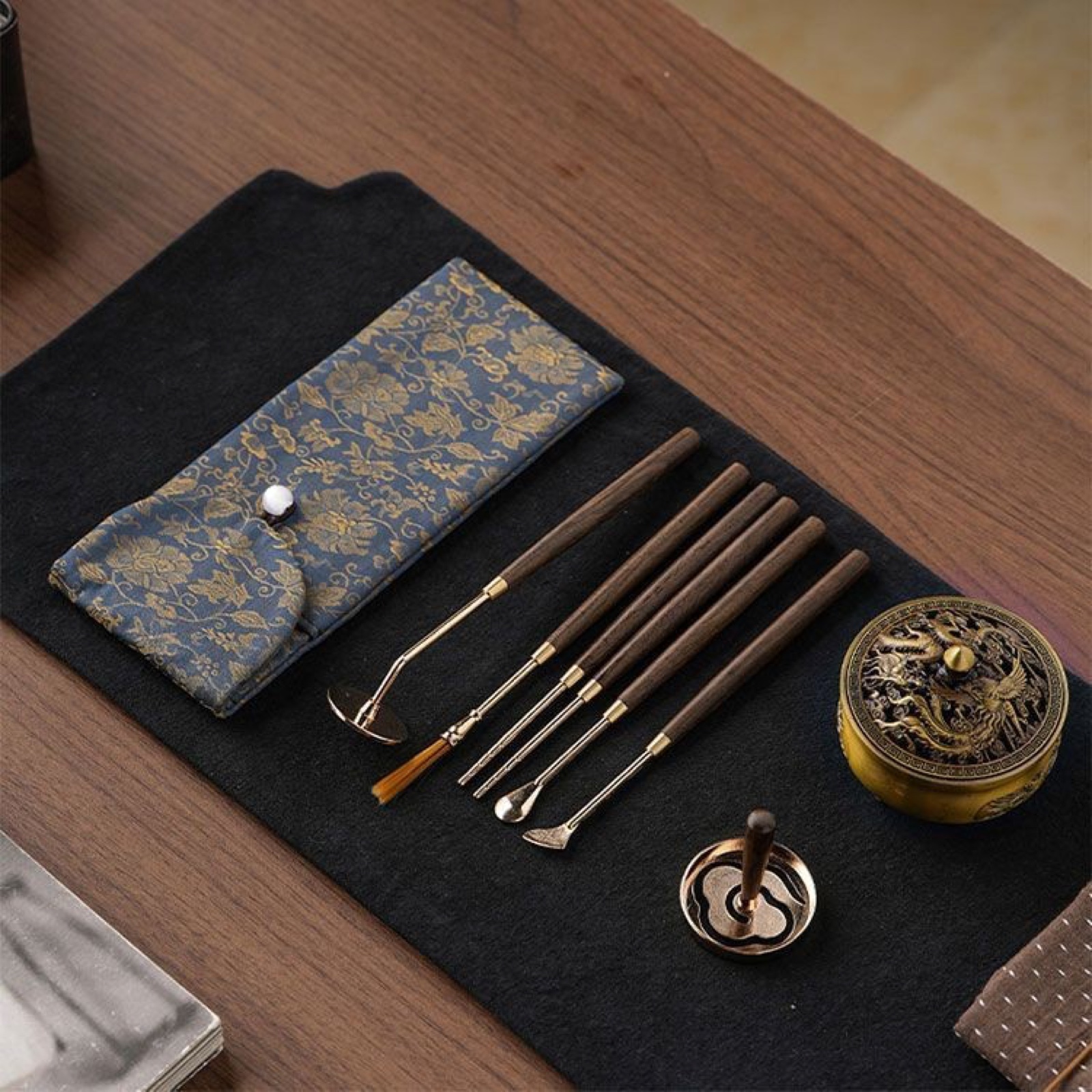
| Shallow tray or censer | 香炉 · 香盘 | Holds the ash bed; must be heat-safe and wider than your stencil |
| Fine ash | 香灰 | The bed the powder sits on. Must be dry and fine |
| Ash press | 灰押 | A flat, heavy disc used to level and firm the ash |
| Brass stencil | 香篆 · 香印 | The pattern. A slot cut through a flat metal plate |
| Spoon | 香匙 | Delivers powder into the slot without scattering it |
| Incense powder | 香粉 | The fuel — fine, dry, and blended to hold shape |
| Lighter or a slow match | — | To light one end |
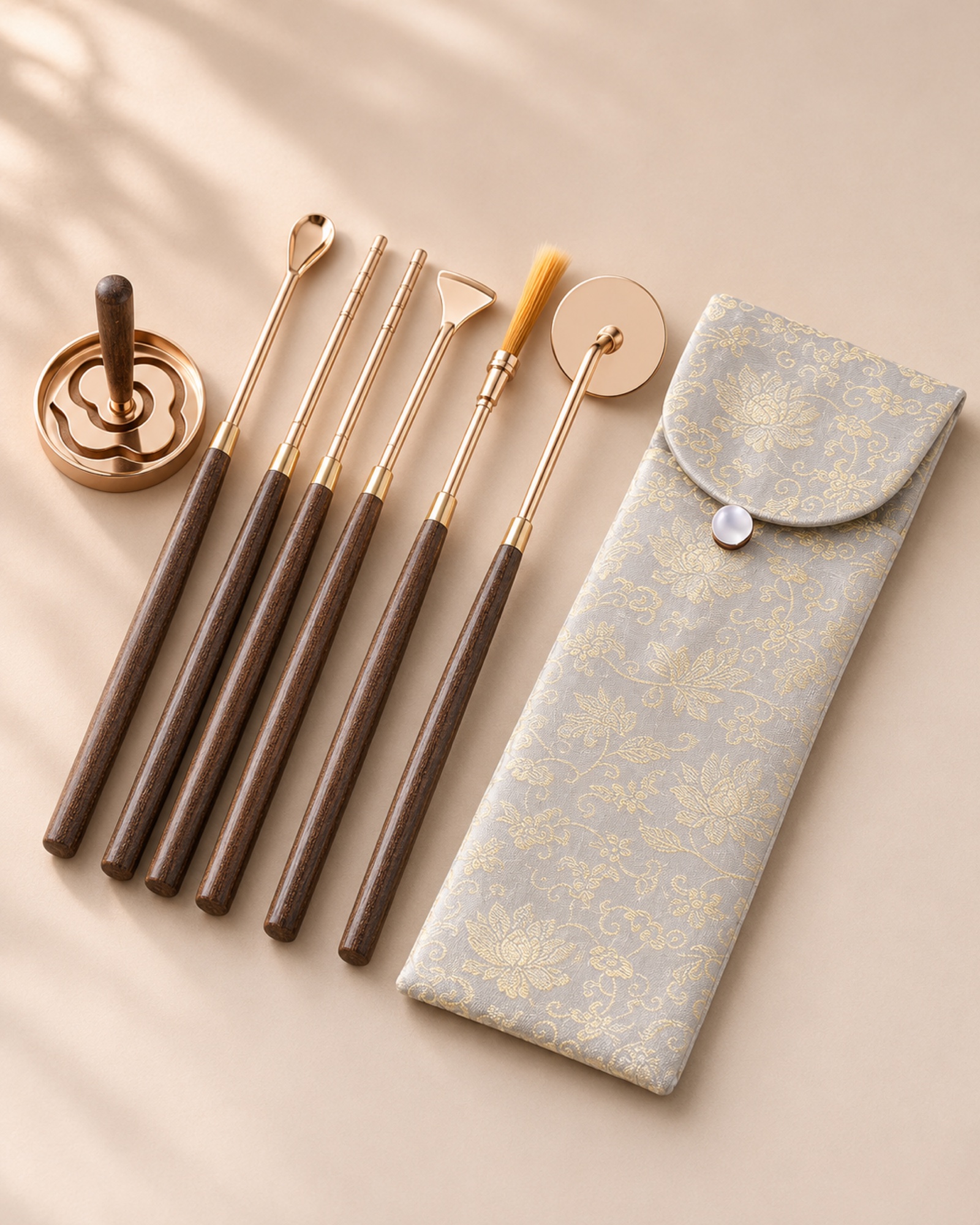
A kit usually combines the tray, press, stencil and spoon. The two things people underestimate are the ash and the powder fineness — see the troubleshooting section.
How do you do it, step by step?
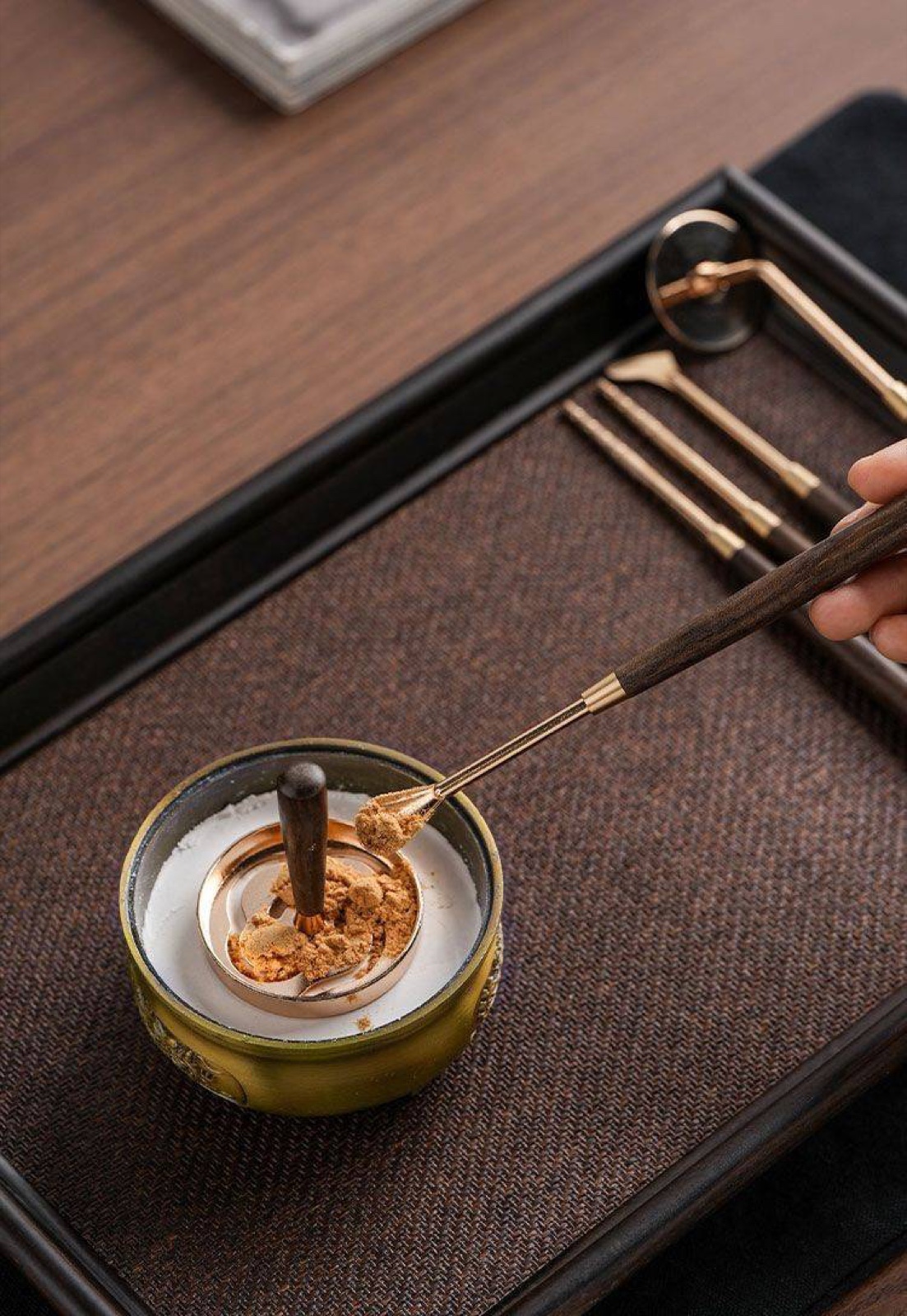
- Fill the tray with ash to about two-thirds depth. Loose, dry, fine ash — not sand, not salt.
- Level and firm it with the ash press. Press evenly, then lift straight up. The surface should be flat, smooth and slightly compacted. This is the step that decides whether the rest works.
- Place the stencil flat on the ash, centred. Do not press it into the ash; it should sit on the surface.
- Spoon powder into the slot. Small amounts at a time, filling the groove as you go around. Do not heap it — a slight mound is right, a pile is not.
- Level the top of the trail with the edge of the spoon or a flat card, so the powder sits flush with the stencil surface.
- Lift the stencil straight up. Slowly, vertically, without any sideways movement. This is where most first attempts fail.
- Light one end of the trail with a lighter, touching only the tip. Let it catch, then withdraw.
- Let it burn. The ember travels the whole pattern. Do not fan it, do not move the tray, and keep the room still.
Why does the trail collapse when I lift the stencil?
| Symptom | Cause | Fix |
|---|---|---|
| Trail crumbles as the stencil lifts | Powder too coarse or too dry | Use a finer powder; some blends need a higher binder proportion |
| Trail collapses at the corners | Ash bed not firm enough | Press the ash harder, and make sure it is fine, not granular |
| Trail breaks in the middle | Stencil lifted at an angle | Lift vertically, both hands, no sideways motion |
| Powder sticks in the slot | Damp powder, or a damp room | Dry the powder; work away from steam and open windows on wet days |
| Ember goes out halfway | Trail too thin at one point, or a draught | Even thickness; move away from vents |
| Trail burns too fast and smells sharp | Powder too dry / too much airflow | Firm the ash, close the draught, use a slightly deeper trail |
| Ash sticks to the powder | Ash bed too deep or too loose | Press the bed; use less ash |
The single highest-leverage fix: powder fineness. Seal powder needs to be finer than stick powder. If you can feel grit between your fingers, it will not hold a trail.
How long does an incense seal burn?
It depends on the pattern length, the trail thickness and the powder — but as a rough guide:
| Pattern | Approximate burn |
|---|---|
| Small character (e.g. 心), thin trail | 20–35 minutes |
| Standard character (福 / 寿) | 45–90 minutes |
| Large rosette or long script | 1.5–3 hours |
This is why the form was used as a clock: the duration is repeatable if the pattern and the powder are the same.
What powder should I use?
Three requirements:
- Fine — finer than for sticks. Sift if necessary.
- Dry — store sealed with a desiccant; damp powder will not hold a trail.
- Blended to hold shape — a formula with enough natural plant binder to keep the trail standing. Pure resin powders will not work; they melt rather than hold.
Single-material powders (pure sandalwood, for instance) can be used but tend to crumble more than a blended formula. This is one of the practical reasons 合香 exists as a technique rather than a preference.
Is it safe?
Loose powder produces an open ember, which is a different risk from a stick in a holder:
- Never leave it unattended. An open ember on a bed of ash is more exposed than a stick.
- Keep the tray on a heat-safe surface, away from anything that can move.
- Do not fan or blow on it to speed it up — embers scatter.
- Ventilate. Loose powder can produce more smoke per minute than a stick.
- Do not attempt to extinguish by stirring. Cap the tray instead, or let it finish.
Frequently asked questions
What is the difference between an incense seal and an incense stencil? Nothing functional — both name the brass plate that forms the trail. “Seal” is the more common term in English; “stencil” describes the mechanism more plainly.
Can I use sand instead of ash? No. Sand does not compact the same way, does not hold heat, and will not support the trail. Use fine incense ash.
Can I reuse the ash? Yes — sieve out charred fragments and hard clumps, top up with fresh ash, and replace the bed every few months. Reusing ash is normal practice, not a shortcut.
Do I need a special powder, or can I grind my own? You can grind your own, but it must be sifted fine and must contain enough natural binder. Home-ground powders often fail on fineness rather than on formula.
Is 香篆 the same as 打香篆? 打香篆 (“pressing the incense seal”) is the name of the activity; 香篆 is the object and the practice. Same thing from two angles.
Explore further
- Chinese incense: what it is and how it’s made
- Types of incense burners: which design catches the ash
- How to clean an incense burner without damaging it
- How to burn resin incense without scorching it
Incense kits and powder — seal tools, ash, and blended powders, with mesh and net weight listed per item. → Incense & Gift Sets