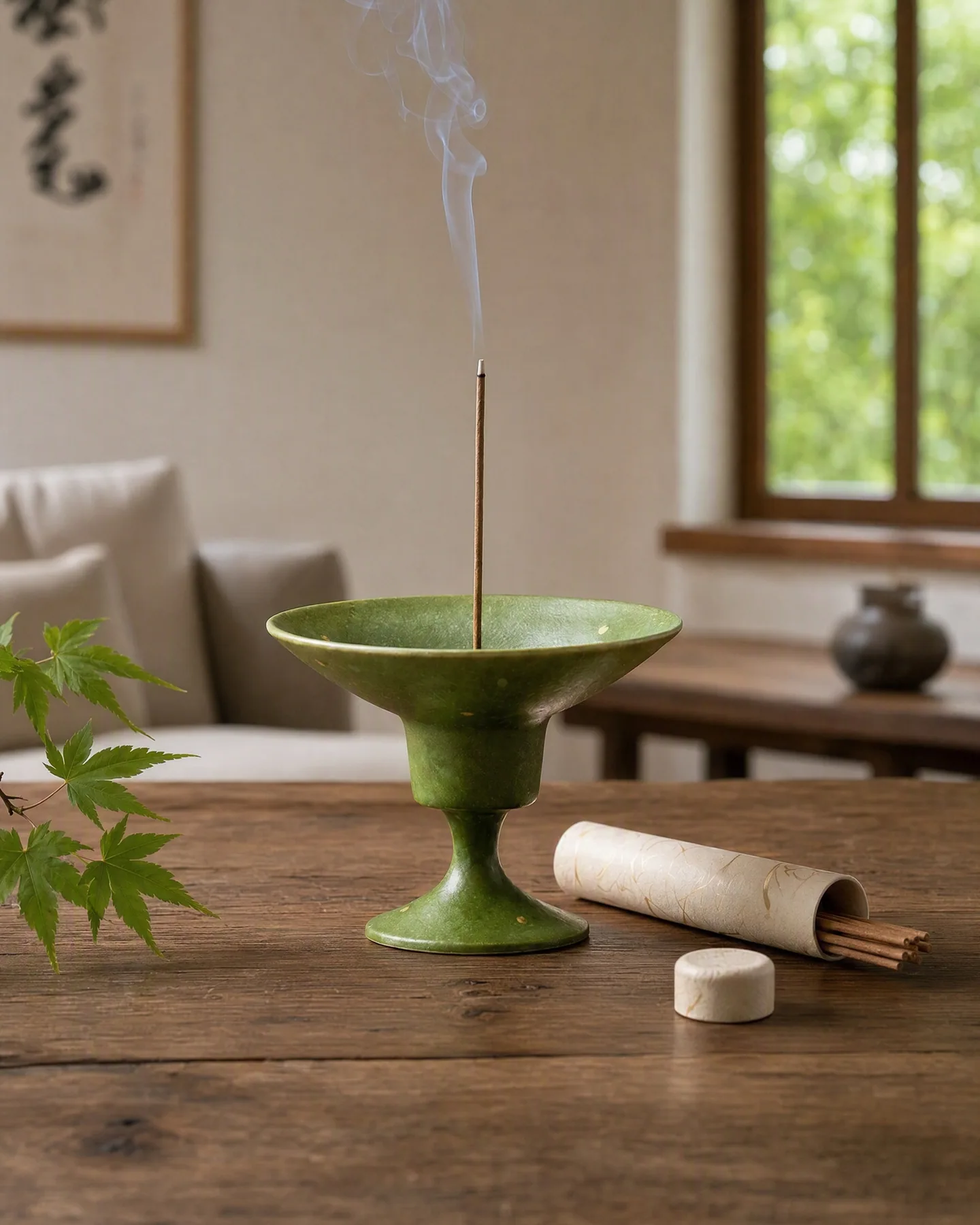
How to Clean an Incense Burner Without Damaging It
Let it cool completely, tip out the ash, and brush the interior dry. Then wash with warm water and one drop of mild dish soap, rinse, and dry fully before the next burn. Resin residue is the exception: it does not dissolve in water, and needs a little neutral oil or isopropyl alcohol instead of scrubbing.
Most damage to incense burners is not caused by burning — it is caused by cleaning. Hot ceramic dropped into cold water, brass scrubbed with an abrasive, wood left soaking. The method below is ordered to avoid all three.
What you need
- A dry soft brush or a paintbrush
- Warm water and one drop of mild dish soap
- A soft cloth
- For resin: a few drops of neutral oil, or isopropyl alcohol on a cloth
- A pin or toothpick for narrow channels
- Not needed: steel wool, scouring powder, bleach, an ultrasonic cleaner
How do you clean an incense burner step by step?
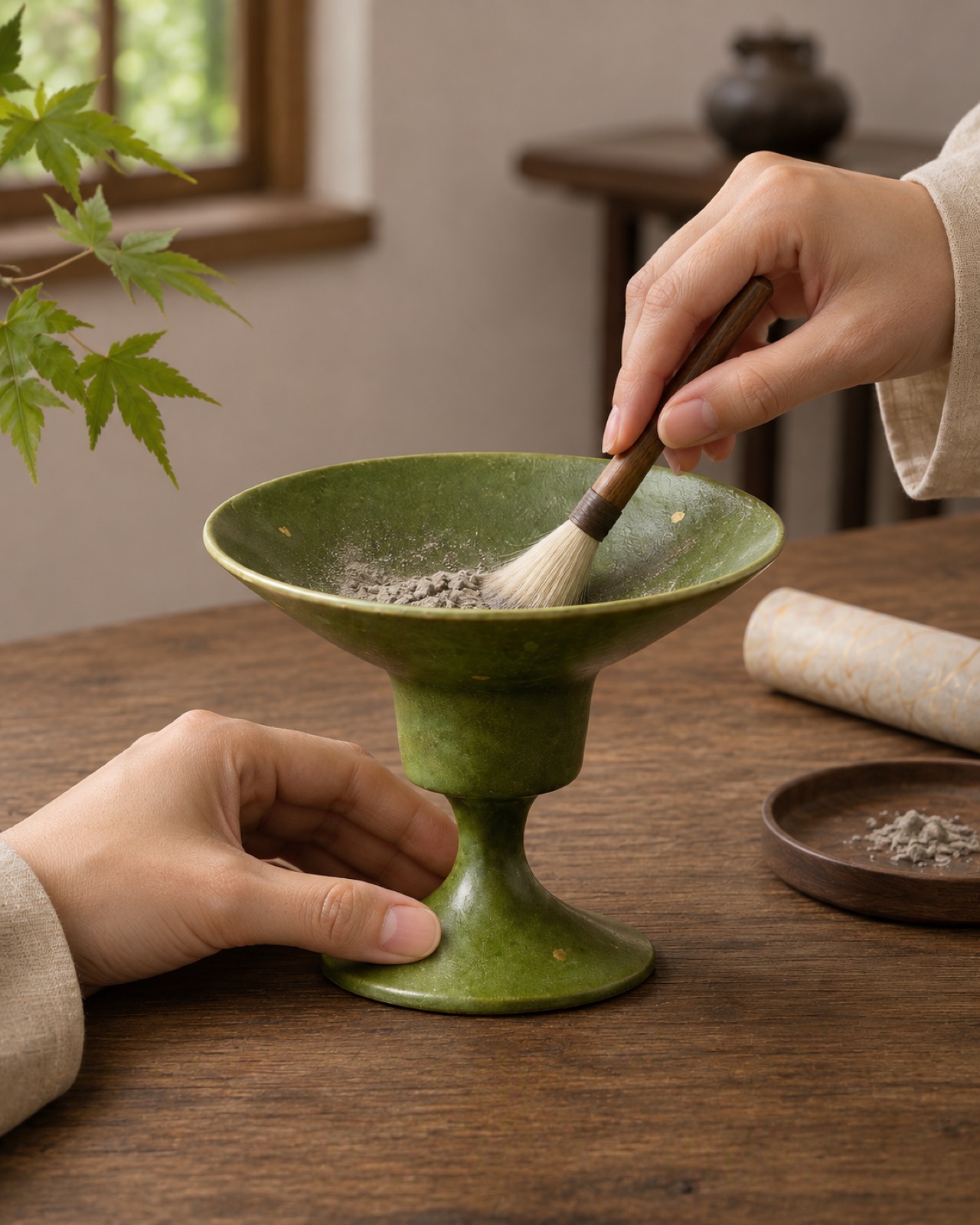
- Wait until it is fully cold. Not warm — cold. This is the step people skip and the step that cracks glaze.
- Tip out loose ash into the bin, over a sink, or onto a plant.
- Brush dry first. A dry brush removes 90% of the residue. Brushing wet ash turns it into a paste that works into every crevice.
- Wash with warm water and one drop of soap. Swirl, do not scrub. For a bowl-form holder, your fingertips are enough.
- Deal with resin separately. See below — it will not come off with soap.
- Rinse thoroughly. Soap residue attracts dust and can leave a film that smells.
- Dry completely with a cloth, then air-dry upside down for an hour. Trapped moisture is what makes the next stick go out.
- Clear the channel (backflow burners, lidded censers) with a pin, from the top.
How do I remove resin residue?
Resin — frankincense, myrrh, benzoin — melts, cools and sets like glue. Water does nothing. Two approaches work:
| Method | How | Notes |
|---|---|---|
| Neutral oil | A few drops of any cooking oil on a cloth; rub the residue; then wash with soap | Safe on ceramic, stone and glass. Takes a few minutes |
| Isopropyl alcohol | 70%+ on a cloth, held against the residue for 30 seconds, then wiped | Fast; do not use on lacquer, painted surfaces or wood |
| Warm water soak | 20 minutes in warm (not hot) water, then a plastic scraper | Slowest, safest for unknown finishes |
Never use a metal scraper. A fingernail, a plastic card or a wooden spatula will do; metal takes the glaze with it.
How do I clean each material?
| Material | Method | Avoid |
|---|---|---|
| Glazed ceramic / porcelain | Warm water, mild soap, soft cloth | Abrasives, thermal shock, dishwasher (glaze can craze) |
| Unglazed ceramic / stoneware | Dry brush mostly; minimal water; dry fully | Soaking — porous bodies hold water and can stain |
| Brass / bronze | Warm water, mild soap, dry immediately | Abrasives; also avoid polishing off patina you want to keep |
| Glass | Warm water, mild soap | Thermal shock; visible film if rinsed poorly |
| Wood | Dry brush and a barely damp cloth only | Soaking, soap, oil unless the maker specifies |
| Soapstone | Dry brush; wipe with a damp cloth | Oil — it stains permanently |
About brass patina: the darkening is a stable oxide layer, not dirt. Polish it off if you want bright brass; leave it if you want the aged look. Either choice is legitimate — just do not scrub half of it off, which looks like neglect rather than patina.
How often should I clean it?
| Use | Clean |
|---|---|
| Daily stick burning | Tip out ash daily; wash weekly |
| Occasional use | Tip out after each use; wash before storage |
| Resin burning | Wipe after every session — resin sets harder with time |
| Backflow burner | Clear the channel every 3–4 cones |
The single habit that prevents most problems: empty while cold, dry fully, store dry.
How do I care for an ash bed?
An ash bed (for powder incense and for holding sticks at an angle) is not cleaned — it is maintained:
- Sieve it occasionally to remove charred fragments and hard clumps.
- Top it up with fresh fine ash to keep the level.
- Replace it every few months, or when it smells acrid even when cold.
- Never wet it. Damp ash will not hold a powder trail and will not support a stick.
How do I remove scorch marks and hard-water stains?
- Scorch marks on ceramic — usually carbon, not damage. A paste of bicarbonate of soda and water, left for ten minutes, then rinsed. If the glaze itself is burnt or blistered, it is permanent; stop using that spot.
- Hard-water rings — white vinegar diluted 1:1, on a cloth, for a minute, then rinse thoroughly. Do not use vinegar on stone or unglazed ceramic.
- Smoke film on the outside — a dry microfibre cloth. Water usually makes it worse.
Frequently asked questions
Can I put an incense burner in the dishwasher? Not recommended for anything you care about. Detergent is aggressive, thermal cycling is severe, and brass will discolour. Hand-wash takes a minute.
My burner smells even when it is empty. Why? Resin and oils have soaked into an unglazed body or a scratched glaze. For glazed pieces, a wash usually fixes it. For unglazed or wooden pieces, the smell is in the material and will fade slowly; store it dry and ventilated.
How do I clean a brass burner without removing the patina? Warm water, a drop of soap, a soft cloth, dry immediately. Do not use polish.
Is it normal for the bowl to stain where the stick stands? Yes. A small dark ring at the centre is normal on unglazed ceramic and stone. It does not affect function.
Explore further
- How to burn incense sticks, step by step
- Types of incense burners: which design catches the ash
- How to burn incense powder
Incenseware for daily use — holders and vessels with care notes per material. → Incenseware & Accessories