Types of Incense Burners: Which Design Actually Catches the Ash
A bowl-form holder catches ash; an open stick holder does not. If ash on the table is your problem, you want a vessel with a lip wide enough to contain the fall — not a flat dish with a hole in the middle. Everything else — backflow burners, censers, coil stands, resin warmers — solves a different problem, and this page sorts them by which one.
The single most common complaint in incense-holder reviews is not scent, and not price. It is mess: ash scattered across a desk, a shelf, a windowsill. The second is fire. Both are design problems, and both are solvable by choosing the right form.
What are the main types of incense burner?
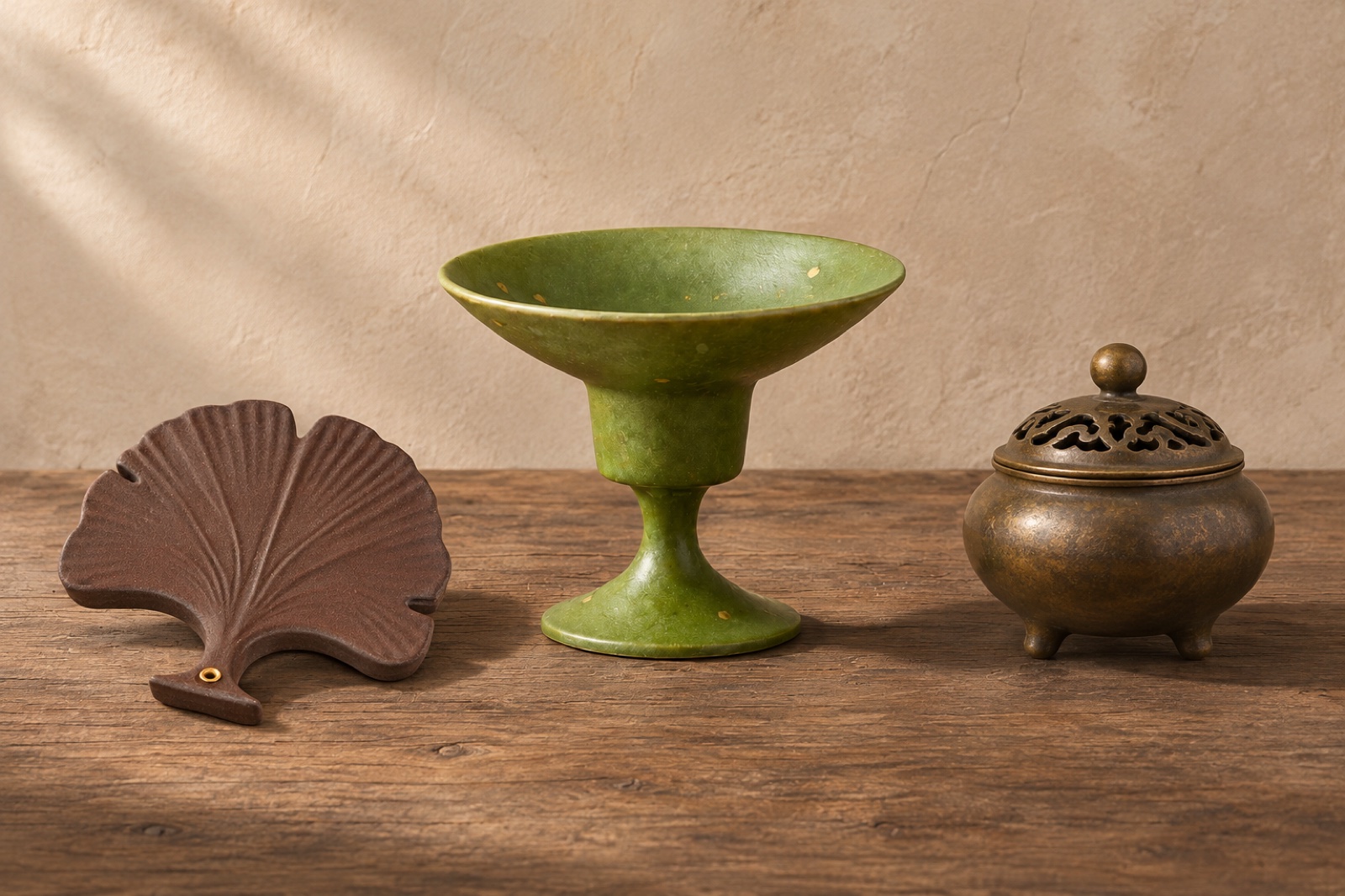
| Type | What it holds | Catches ash? | Best for |
|---|---|---|---|
| Bowl-form holder | One stick, upright in a centre hole or a small ash bed | Yes — fully | Daily stick burning on a desk or table |
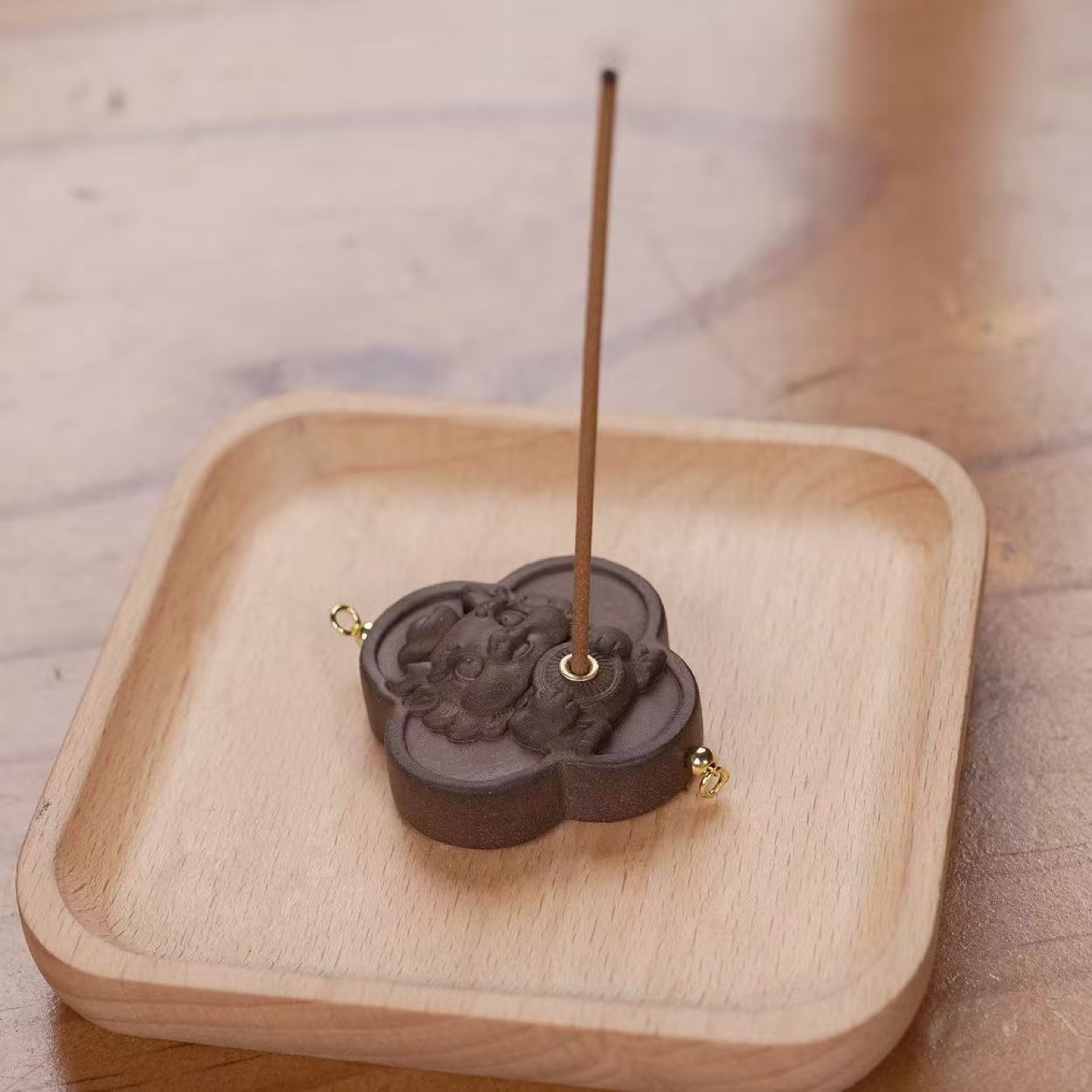
| Flat stick holder | One stick, laid at a shallow angle | Partially — a small trough catches some | Portability, travel, minimal footprint |
| Backflow burner | A cone, over a chamber | Yes, and the smoke flows downward | Visual effect; a deliberate centrepiece |
| Censer (lidded vessel) | Coils, cones or loose powder | Yes, but the lid hides the ash | Longer burns, traditional settings, ceremony |
| Coil stand | A spiral coil, hung or suspended | No — ash falls freely | Long burns in a ventilated, non-fragile space |
| Resin warmer | Resin over indirect heat | Not applicable — no combustion ash | Resins, and anyone avoiding smoke |
| Seal / powder tray | Loose powder pressed into a pattern | Yes — the tray is the boundary | Powder incense, 香篆 practice |
Which design actually keeps ash off the table?
Three designs do it properly, for three different reasons:
1. Bowl form — containment by geometry. The stick stands in the centre and the vessel wall surrounds it on all sides. Ash falls a few centimetres and lands inside. This is the only design where ash capture is a structural property rather than an add-on. The requirement is a lip higher than the fall and a base wide enough that the stick is not near the edge.
2. Censer — containment by enclosure. A lidded vessel holds the ash and lets smoke out through pierced openings. It works, but it changes the experience: you stop watching the ember, and the ash becomes invisible rather than captured. Traditionally used for coils and powder, where burns are long.
3. Powder tray — containment by boundary. Powder incense is burned inside a defined shape on a bed of ash, in a tray. The tray is the boundary and the ash bed absorbs what falls. This is the traditional 香篆 setup, and it is the most controlled of the three — at the cost of setup time.
What does not work: a flat holder with a small trough. It catches the first centimetre of ash and releases the rest. It is fine for a five-minute stick on a balcony; it is not fine on a lacquered desk.
What materials are used, and what changes?
| Material | What it does well | What to know |
|---|---|---|
| Ceramic / porcelain | Easy to clean, no reaction with ash, stable | Can chip; thermal shock if a hot ember is dropped in cold water |
| Glazed stoneware | Same, with more weight | Glaze can craze over years; harmless but visible |
| Brass | Traditional, develops patina, heavy enough not to tip | Patina is expected; polish removes it deliberately. Clean with a dry cloth, not abrasives |
| Glass | Shows the ash — which is the opposite of what you want | Use for backflow displays, where the fall is the point |
| Wood | Warm, light | Scorch risk if the ember tips; keep a metal or ceramic insert between stick and wood |
| Stone / soapstone | Heavy, cool, stable | Porous stones can stain permanently with resin |
For a first burner, ceramic or glazed stoneware is the low-risk choice: it will not scorch, it will not react with ash, and it cleans with warm water.
What size do you need?
Two numbers decide it:
- Stick length. Standard sticks run 20–25 cm. A bowl must be at least as tall as roughly a third of the stick, or the stick becomes top-heavy and tips when the ember reaches the balance point.
- Bowl opening. Wide enough that the stick is at least 3 cm from the rim at its closest point. Closer than that, and ash lands on the table edge rather than in the bowl.
For coils, the constraint is the diameter of the coil plus clearance — most lidded censers are built around a specific coil size, so check before buying.
What about fire safety?
Non-negotiable, in order:
- Never leave a burning stick unattended. Not while you shower, not while you sleep.
- Keep it away from anything that can move. Curtains, paper, pets, children. A bowl helps here: it is harder to knock an ember out of a vessel than off a flat dish.
- Use a heat-tolerant base. A ceramic burner on a wooden shelf is fine; a thin metal dish on the same shelf is not.
- Ventilate. Any combustion produces smoke. A closed room with a burning stick is a poor idea regardless of what the stick is made of.
- Extinguish properly. Press the ember flat against a ceramic surface, or cap it. Do not run it under water — the thermal shock can crack both the stick and the holder.
- If you have a respiratory condition, treat smoke of any kind with caution. This is not a product-specific warning; it applies to incense generally.
Which burner for which kind of incense?
| What you burn | Right vessel |
|---|---|
| Sticks, daily | Bowl-form holder |
| Sticks, travel | Flat holder with a trough |
| Cones | Bowl or censer with a heat-safe base |
| Coils | Coil stand or a wide lidded censer |
| Loose powder / seal | Powder tray with an ash bed |
| Resin | Electric warmer, or charcoal with a mica plate |
If you are starting from nothing, buy one bowl-form holder and one small powder tray. Between them they cover sticks, cones and powder, which is most of what a household actually burns.
Frequently asked questions
What is the difference between an incense burner and an incense holder? In practice, little. “Holder” usually means a smaller object that supports a stick; “burner” can mean the same, or a larger vessel for coils, cones and powder. The useful distinction is whether the object contains ash, not what it is called.
Do I need a special holder for backflow cones? Yes. Backflow cones are designed to burn with the smoke descending into a chamber, and they only work in a backflow burner with the matching internal structure.
Can I use a bowl-form holder for cones? Yes, if the base can take heat. Cones burn hotter at the base than sticks do; a ceramic bowl handles it, a wooden one does not without an insert.
How do I stop ash from sticking to the bowl? Empty it when cool, not hot. Warm ash smears. A dry paper towel is usually enough; for resin residue, a drop of neutral oil, then wash with warm water.
Is a brass burner better than ceramic? Different, not better. Brass is heavier and traditional; ceramic is easier to clean and cheaper. Neither affects the scent.
Explore further
- How to burn incense sticks, step by step
- How to clean an incense burner without damaging it
- What is a backflow incense burner
- The censer: history and meaning
Incenseware for daily use — bowl-form holders, ash beds and powder trays, with dimensions and materials listed per piece. → Incenseware & Accessories