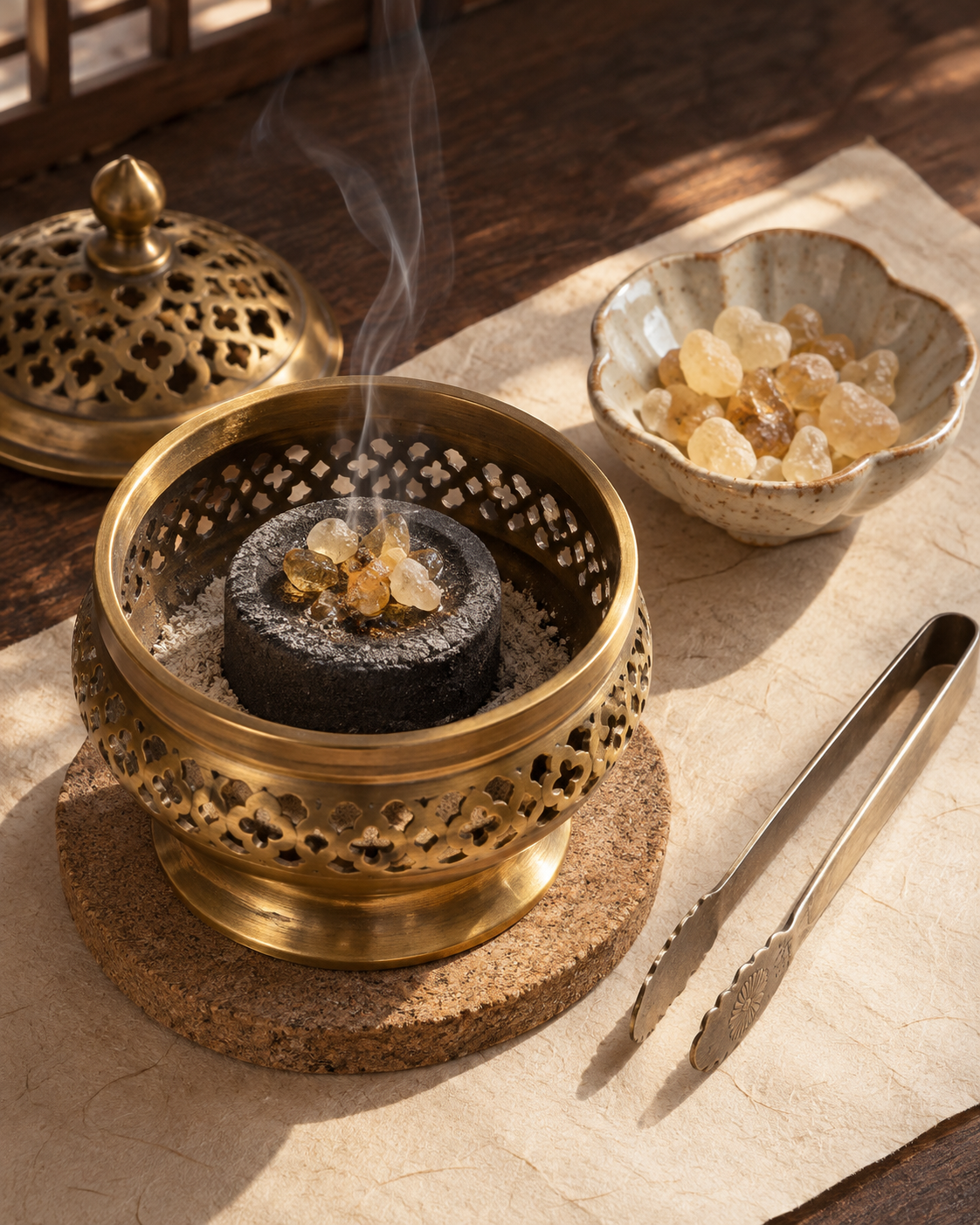
How to Burn Resin Incense Without Scorching It
For a controlled scent indoors, warm resin indirectly rather than placing it in direct flame. Start with a small piece on a mica or metal plate over a heat source, then raise the temperature gradually. If it produces dark smoke or an acrid smell, reduce the heat.
Temperature, quantity and the resin itself all affect the result. Indirect heat makes those variables easier to control and reduces scorching.
What is resin incense?
Plant resin is the hardened sap of certain trees and shrubs, collected and dried. The classic materials:
| Resin | Character | Notes |
|---|---|---|
| Frankincense | Bright, citrus-resinous, slightly green | Boswellia species; tears or powder |
| Myrrh | Bitter, dark, medicinal-adjacent | Commiphora species; often used in blends |
| Benzoin | Sweet, vanilla-like, heavy | Styrax; sticky, use small pieces |
| Copal | Clean, piney, smoky | Many Bursera species; hard and clear |
| Dragon’s blood | Deep, red-brown, sweet-smoky | Dracaena; stains — protect the surface |
Note on words: “burning resin” is the common phrase, but the method is closer to melting. Some traditions do burn it directly on charcoal; most modern home practice warms it.
How do you burn resin incense?
Method 1 — Electric warmer (recommended for indoors)
- Set the warmer to its lowest setting and let it come to temperature.
- Place a piece of resin — pea-sized to start — on the mica or metal dish. Never directly on the element.
- Wait. At low heat, resin softens and releases a slow scent over 20–40 minutes.
- Raise the setting one step at a time if you want more intensity. Most resins do not need the top setting.
- When the scent fades, the resin has spent itself. Let it cool before removing; it sets hard.
Why this is the recommended method: no charcoal or open flame, and the temperature is repeatable. It makes it easier to find and maintain a suitable setting.
Method 2 — Charcoal and mica plate (traditional)
- Light a charcoal disc outdoors or in a well-ventilated space, and let it grey over completely. A disc with visible black edges is still too hot.
- Place the disc in a heat-proof bowl, and lay a bed of sand around it.
- Put a mica plate — or a piece of aluminium foil — on the disc.
- Place the resin on the plate, not on the charcoal.
- Add resin in small amounts; replace the plate when it blackens.
Why the plate matters: it separates the resin from direct contact with the charcoal, moderates the heat and keeps residue off the bowl.
Method 3 — Tealight warmer / simmering plate
A low-cost compromise: a metal plate over a tealight. Works, but the temperature is not adjustable, and it tends to run hot at the start.
How much resin should I use?
Start with a very small piece and increase only if needed. Resin strength, warmer temperature and room size vary, so a fixed quantity cannot predict how strongly it will scent a space. Stop and ventilate if the vapour or smoke causes discomfort.
For a first try, use one piece, note how long it lasts, and adjust next time.
Why does my resin smell bitter or burnt?
| Symptom | Cause | Fix |
|---|---|---|
| Sharp, acrid, burnt smell | Too hot — resin is scorching | Lower the heat; use a mica plate; move further from the source |
| Black smoke | Direct contact with charcoal or element | Always use a plate |
| Bubbles and spits | Moisture in the resin, or sudden high heat | Warm slowly; use dry resin |
| No scent at all | Too cool, or the piece is too large to heat through | Raise the setting; break into smaller pieces |
| Scent fades in 5 minutes | Piece too small, or too hot (it burns off fast) | Use a slightly larger piece at lower heat |
| Sticky residue that will not clean | Benzoin or other soft resins | Oil, then soap; see cleaning guide |
Is resin incense safe indoors?
Resin produces less visible smoke when warmed than when burned, which is why people assume it is harmless. Treat it with the same care as any incense:
- Ventilate. Warm resin still releases volatile compounds into the room.
- Keep the piece small. Intensity rises fast with quantity.
- Never leave charcoal unattended. A lit charcoal disc is an open heat source that stays hot for a long time.
- Protect surfaces. Dragon’s blood and benzoin stain; use a tray.
- If you have a respiratory condition, treat any airborne smoke or vapour with caution and stop if it irritates.
- Keep animals away from smoke and heated materials. If an animal has respiratory sensitivity, seek species-specific advice from a veterinarian before using incense nearby.
Can I mix resin with other incense?
Yes, and it is traditional. A few grains of resin added to a powder blend, or warmed alongside a stick, changes the top note. Two practical cautions:
- Do not add resin to a stick’s ember. It will scorch and smell bitter.
- Add small, and one at a time. Resin dominates blends quickly.
Frequently asked questions
Do I need charcoal to burn resin? No. An electric warmer is cleaner, safer and more controllable. Charcoal is for tradition and for larger quantities.
Can I warm resin over a candle? Only in a purpose-built, stable warmer with a heat-resistant plate and adequate clearance. Never place resin directly in the flame or leave the warmer unattended.
How long does a piece last? It varies with resin type, piece size and temperature. Begin at low heat and replace it when the scent has faded rather than relying on a fixed time.
Can I reuse resin after it has cooled? Sometimes. A cooled piece can be warmed again if it still releases a clean scent. Discard it once the scent has faded or the residue smells scorched.
What is the mica plate for? It spreads heat evenly and keeps resin off the charcoal, which is the difference between warming and scorching.
Explore further
- How to burn incense powder and use an incense seal
- How to clean an incense burner without damaging it
- Types of incense burners: which design catches the ash
Resin and blended incense — materials and net weights listed per item. → Incense collection