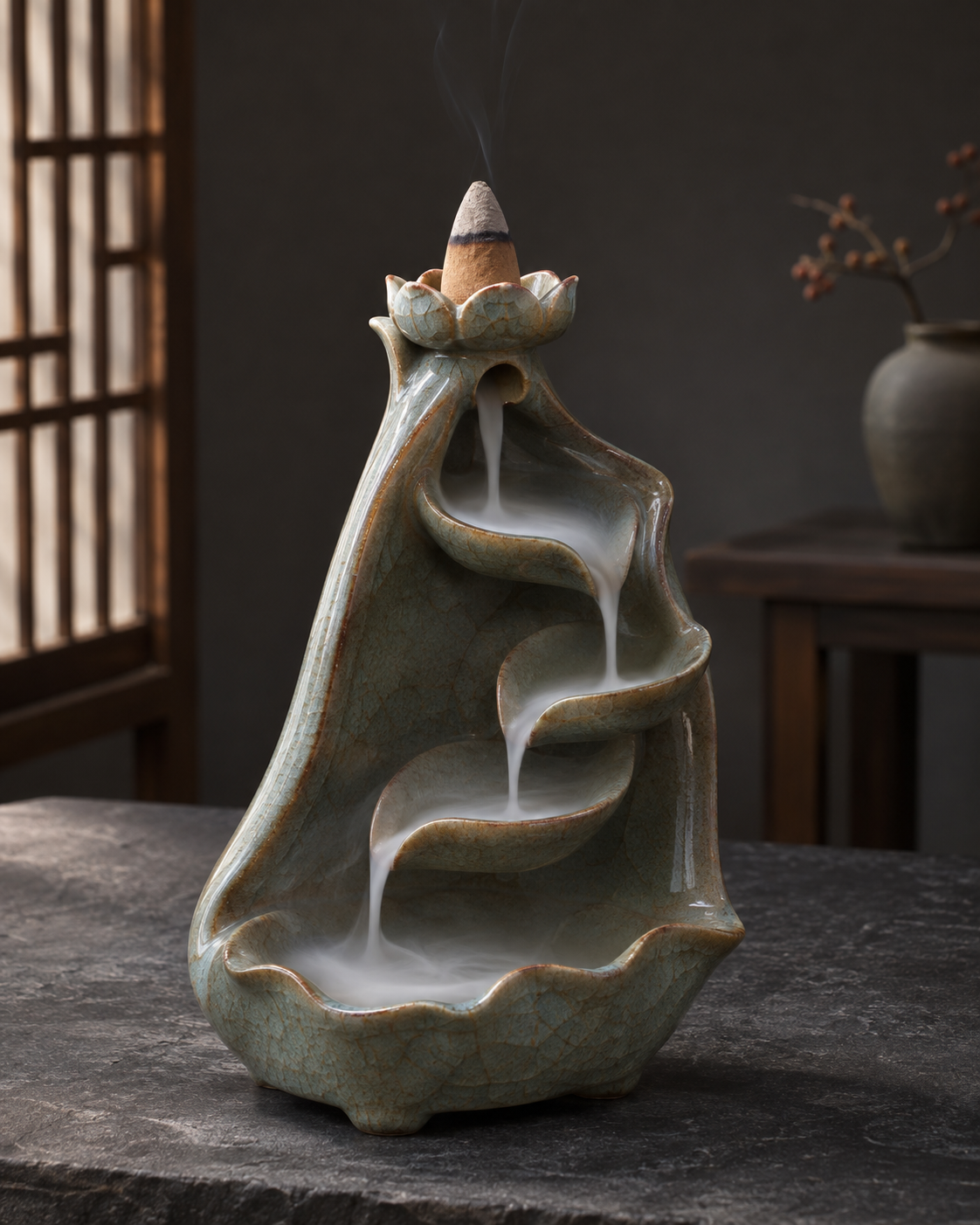
What Is a Backflow Incense Burner and How Does It Work?
A backflow incense burner is a two-part object: a hollow cone and a burner with a channel below it. Combustion gases can travel through the aligned openings; after cooling in still air, the smoke-laden air descends and produces the “waterfall” effect. It only works with a backflow cone correctly aligned to a burner built for it.
It is one of the few incense objects where the visual effect is the entire point. That also makes it the one most likely to disappoint, because the effect depends on three things lining up: the cone, the chamber, and the air in the room.
How does the smoke go down instead of up?
Hot smoke normally rises. A backflow system instead gives some of the combustion gases a downward route and time to cool:
- The cone is hollow. A channel through the cone gives the combustion gases a second path besides rising from the tip.
- The base has a channel. A small hole runs through the bottom of the cone, aligned with a hole in the burner’s platform.
- The chamber shelters the flow. In still air, the descending smoke-laden air can remain visible and spill over the internal structure as a waterfall or cascade.
The effect is not a trick of lighting. It is a density difference, and it disappears the moment the air in the room moves.
Do I need special cones?
Yes. A standard cone has a closed base; there is no channel to align with the burner. A backflow cone is made with a hollow passage through its base so gases can enter the chamber below.
Two consequences people discover the hard way:
- A backflow cone in a normal holder will still burn, but the smoke simply rises. The cone is not wasted; the effect just does not happen.
- A normal cone in a backflow burner will not flow, and the unburned residue tends to clog the burner’s channel.
Why has my backflow burner stopped flowing?
Work down this list in order. In most cases the cause is in the first three rows.
| Symptom | Likely cause | Fix |
|---|---|---|
| Smoke rises, no flow at all | Wrong cone type | Check the base of the cone for a hole |
| Flow starts, then stops halfway | Draught in the room | Close the window, move away from an air vent or a fan |
| Weak, thin trickle | Burner channel blocked with residue | Clear the channel with a pin; soak the platform in warm water |
| Flow goes sideways, not down | Burner not level, or cone seated off-centre | Level the surface; seat the cone exactly over the hole |
| Works for 2 minutes, then nothing | Cone too moist from storage | Dry the cone; store sealed with a desiccant |
| No flow and the cone goes out | Cone sitting in its own ash, air starved | Clear the platform between burns |
The single most common cause is air movement — not a defective product. A backflow burner is a still-air device.
Is the smoke from a backflow burner different?
The visible flow behaves differently because it has travelled through a channel and cooled in a sheltered chamber. That does not make the emissions safer. Cone ingredients vary by maker, so use a supplier that discloses its materials rather than guessing from the visual effect or scent alone.
Practical guidance:
- Ventilate the room. The visual effect is not a reason to sit in smoke.
- Do not leave it burning unattended, and keep it away from anything that can catch.
- If you have a respiratory condition, treat any smoke with caution. Nothing about the downward flow makes the smoke safer to breathe.
- If the smell is sharp or chemical rather than woody, that is usually the fragrance load, not the incense. Switch cones.
Is this an ancient form?
The commercial backflow burner is a modern product, but this article does not assign it a precise invention date. Its hollow cone and aligned channel differ from historic censers, even when the vessel borrows mountain forms or other traditional motifs.
The aesthetic it borrows from is old: lidded vessels, mountain forms, and the tradition of watching smoke move through a covered censer. The waterfall mechanism should not be presented as an established Song-dynasty practice without evidence.
For the older vessel tradition it borrows from, see the censer: history and meaning.
How do you clean one?
The channel is the part that fails, so clean it before it clogs:
- Let the burner cool completely.
- Tip out loose ash; brush the platform with a dry brush.
- Push a pin or a toothpick through the channel — gently, from the top.
- For resinous build-up, soak the platform in warm water with a drop of neutral detergent, then rinse and dry fully.
- Never put a hot burner into cold water. Thermal shock cracks glaze and stoneware.
Frequency: after every three to four cones if you burn regularly. A clogged channel is the second most common reason a burner “stops working”.
What should I look for when buying one?
| Check | Why it matters |
|---|---|
| Channel alignment | The cone hole and the burner channel must line up. Off by a millimetre and the flow is weak. |
| Chamber volume | Too small and the smoke has nowhere to pool; too large and it dissipates before it spills. |
| Stability of the base | A top-heavy burner on a polished shelf will be knocked over. |
| Material at the platform | The platform takes the heat. Ceramic and stone are fine; thin wood is not. |
| Whether cones are included, and whether they are the same maker’s | Cross-brand cone/burner combinations are the most common source of disappointment. |
Frequently asked questions
Can I use normal incense sticks in a backflow burner? You can rest a stick in most backflow burners, and it will burn normally — but the smoke will rise. The downward effect requires a backflow cone.
Why does the smoke sometimes pool and not spill? The chamber is in a dead-still pocket of air, or the cone is producing too little smoke. A very slight air movement usually starts the spill; too much stops it entirely.
Are backflow cones safe to burn indoors? They produce smoke like any incense. Ventilate, do not leave unattended, and treat smoke with caution if you have a respiratory condition. The downward flow does not change what you are breathing.
Do backflow burners need special cleaning? Only the channel, and only because residue blocks it. Warm water and a pin are enough.
Explore further
- Types of incense burners: which design catches the ash
- The censer: history and meaning
- How to clean an incense burner without damaging it
Incenseware for daily use — bowl-form holders and vessels, with dimensions and materials listed per piece. → Incenseware & Accessories