How to Burn Incense Sticks, Step by Step
Hold the stick at a downward angle, light the tip, let it flame for two to three seconds, then blow the flame out. Stand the stick upright in a holder. A correctly lit stick has a glowing ember and a thin, steady thread of smoke — if there is a flame, it is still catching; if there is no ember, it has gone out.
That is the whole method. Everything below is about the four ways it usually goes wrong.
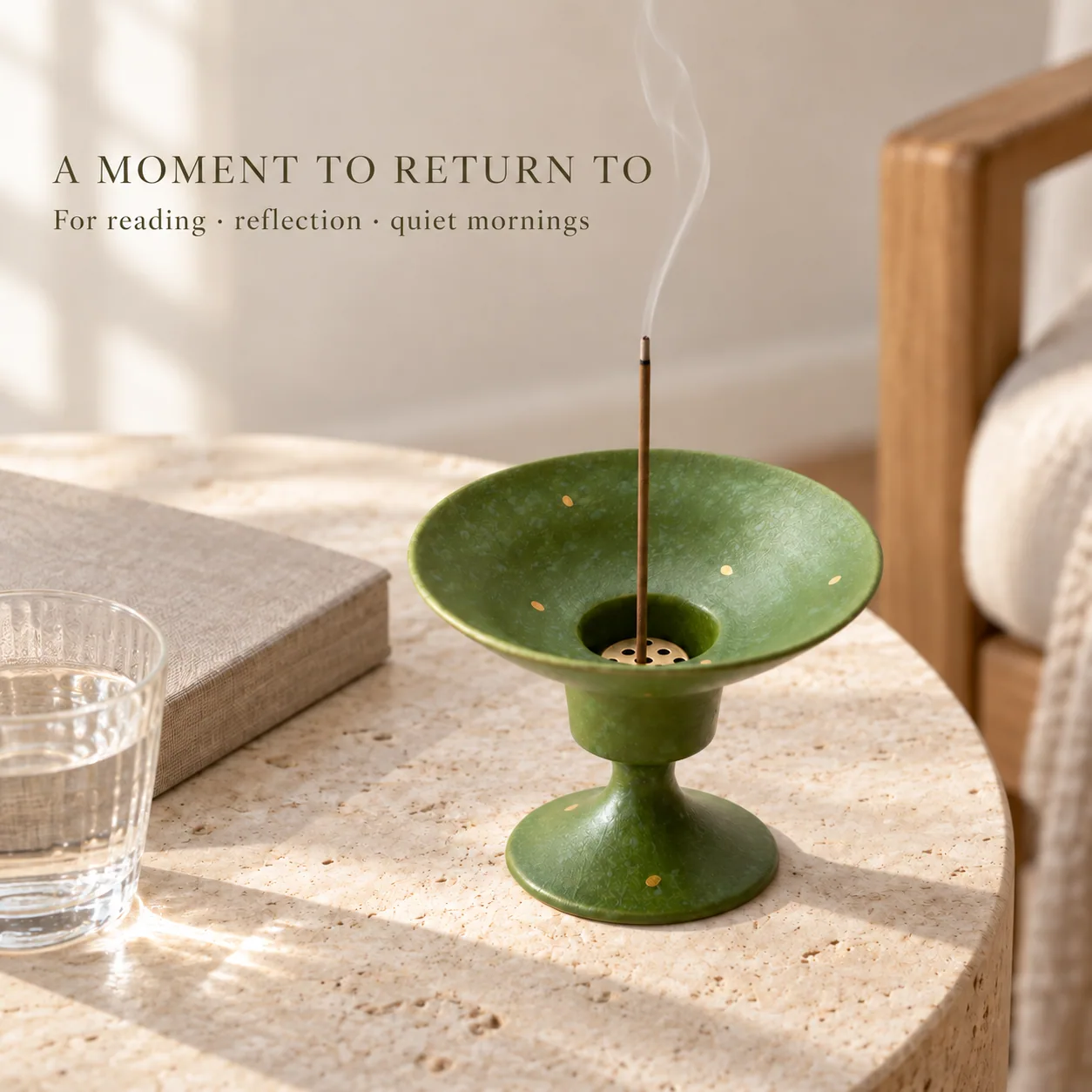 Ember, not flame. The glow at the tip is what does the work.
How do you burn incense sticks, step by step?
- Choose a still, heat-safe spot. Away from curtains, paper, children and pets, and anything that can be knocked. A holder on a stable surface, not on a shelf edge.
- Set the stick in the holder. Upright in a centre hole, or at a slight angle in an ash bed. If it leans, it will fall when the ember passes the balance point.
- Light the tip at an angle. Hold the stick tilted down so the flame travels up into the tip rather than away from it. A lighter is easier than a match; a match is easier than a candle.
- Let it flame for two to three seconds. The tip needs to catch, not just blacken. A brief flame is normal.
- Blow the flame out — gently. A soft puff, or fan it with your hand. Do not blow hard: you can blow the ember off the tip and leave an unlit stick.
- Check the ember. The tip should glow orange and give a thin, continuous thread of smoke. No glow means it has not caught; relight.
- Leave it alone. Do not move the holder while it burns, and never leave a burning stick unattended. Extinguish it completely before leaving the room or going to sleep.
Why does my incense keep going out?
| Symptom | Cause | Fix |
|---|---|---|
| Goes out within a minute | Tip never properly caught | Hold the flame longer — 3–4 seconds — and confirm the ember before walking away |
| Burns halfway, then dies | Draught, or the stick is leaning against the holder | Move away from vents and open windows; reseat the stick upright |
| Will not stay lit at all | Damp stick | Dry it: sealed bag with a desiccant for a day. Store sticks sealed, away from bathrooms |
| Burns unevenly, one side only | Bent or poorly extruded stick | Rotate the stick 180° when you relight; discard sticks that are visibly warped |
| Flame keeps re-igniting | Too much air, or the stick is very dry and resin-rich | Blow out again and let the ember settle; rich sticks can re-flame once |
| Very smoky, black smoke | Stick touching the holder, or burning in a dead-air corner | Reposition; ensure some airflow in the room |
Should I blow out the flame or let it burn?
Blow it out. A stick left flaming burns too fast, scorches the tip, and produces acrid smoke. The ember is what you want. If you dislike blowing on it, fan it with your hand or a piece of card — same result, less spit.
How long does an incense stick burn?
It depends almost entirely on length and diameter, not on price:
| Stick type | Typical length | Typical burn time |
|---|---|---|
| Short / sample | 10–13 cm | 15–25 minutes |
| Standard | 20–21 cm | 30–45 minutes |
| Long | 25–33 cm | 45–75 minutes |
| Thick / hand-rolled | 20–25 cm | 50–80 minutes |
Thickness matters more than length: two sticks of the same length can differ by half an hour if one is twice as thick. If a seller quotes a burn time without a length, the number is not useful.
Where should the holder go?
Three conditions:
- Still air. Draughts make sticks burn unevenly and go out. A corner is better than a windowsill.
- Heat-safe base. Ceramic or stone, or another stable, heat-tolerant, non-combustible surface under the holder.
- Within sight. The single rule that prevents most incidents: never burn a stick in a room you are not in.
A bowl-form holder solves the ash problem at the same time. The detailed burner guide remains in editorial review.
Is the smoke safe to breathe?
Smoke of any kind is not nothing. Practical guidance, without overclaiming in either direction:
- Ventilate. Burning incense produces particulate matter; whether ventilation is sufficient depends on the room size, how much you burn, how long you burn, and the ventilation available. Keep air circulating and burn a small amount at a time. If the smoke or scent causes discomfort, stop burning and leave the room or ventilate it.
- One stick at a time is a different exposure from a room full of them.
- If you are sensitive to smoke — for example, if you have asthma or another respiratory condition — avoid incense, or consult a qualified medical professional before use.
- Keep smoke away from infants, children and pets. If a pet has a specific health condition, consult a veterinarian.
- Never leave a burning stick unattended, and never burn while sleeping.
How do I put it out before it finishes?
Following the product or holder instructions, press the burning end into sand or a heat-tolerant, non-combustible container, or safely submerge the tip to extinguish it. Before handling, confirm the ember and any ash are fully out, and avoid suddenly plunging a hot holder into water. A dedicated extinguishing guide remains in editorial review.
Frequently asked questions
Do you light the thick end or the thin end? The tip — whichever end is coated and tapered. Hand-rolled sticks sometimes have a slightly thicker base, which goes into the holder.
Why does my incense smell burnt rather than fragrant? Usually too much flame at the start, or the stick is too close to the holder so the smoke is re-heated. Blow out the flame earlier and raise the stick.
Can I burn incense sticks in a bedroom? Only if you stay awake and attentive and the room can be well ventilated. Extinguish the stick completely before you go to sleep, and avoid it if you are sensitive to smoke.
Do I need an ash bed? Not for sticks. An ash bed is for loose powder and for holding sticks at an angle. A centre hole is enough for an upright stick.
How should I store sticks? Sealed, dry, out of sunlight, away from the bathroom. Damp sticks are the most common cause of “bad batch” complaints.
Explore further
More care, burner and incense-powder guides are complete and remain in editorial review. Browse the published Museum archive as new guides pass the release gate.
Incense for daily burning — sticks, coils and cones, with burn time and dimensions listed per item. → Incense collection