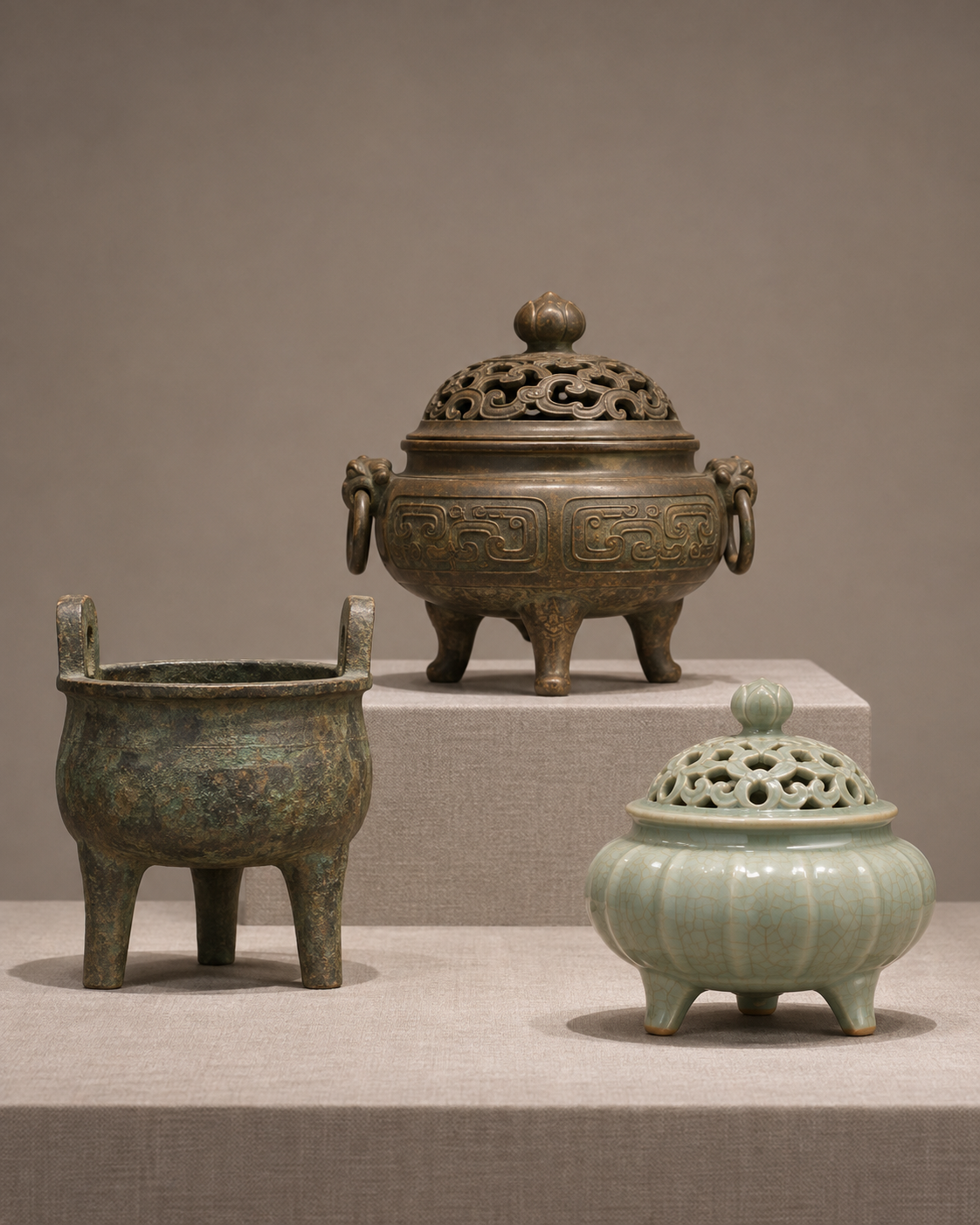
The Censer: What It Is, and 2,000 Years of Burning Incense in a Vessel
A censer is a vessel designed to hold burning incense. In Christian liturgy it is a metal bowl suspended on chains, swung to release smoke; in Chinese and Japanese practice it is a standing vessel — bronze, ceramic or stone — set on a table or an altar. The word covers both because the function is identical: contain the fire, release the smoke, catch the ash.
Two entirely different traditions arrive at the same object, and English gives them the same word. That is why a search for “censer” returns church metalwork next to Song dynasty ceramics. Both are correct. This page covers the definition, then the history of each.
What does “censer” mean?
The word comes from the Latin incensum, “that which is burned”, through Old French encensier — a vessel for burning incense. It has been in English since the 13th century, and it has always meant the vessel rather than the incense.
Two senses are in current use:
| Sense | What it looks like | Where you see it |
|---|---|---|
| Liturgical censer (thurible) | A metal bowl on three or four chains, with a lid | Christian churches, especially Catholic, Orthodox and high Anglican |
| Standing censer (香炉, xiāng lú) | A bowl or a tripod vessel, often lidded, on a foot or legs | Chinese and Japanese temples, tea rooms, homes, museums |
They are not variations of one object. They developed separately, for different liturgies, and only converge in the English word.
How is a censer used in Christian liturgy?
The thurible is loaded with ignited charcoal, and grains of incense — usually frankincense — are placed on the coals. It is then swung on its chains by a thurifer, and the smoke is directed toward the altar, the Gospel book, the gifts, or the congregation, depending on the moment in the service.
The mechanics matter to the object’s design:
- Chains allow the bowl to swing without spilling coals, and let the smoke be aimed.
- A lid with vent holes controls the burn and prevents sparks.
- A heat-resistant bowl, traditionally bronze or brass, takes repeated thermal cycling.
- A base plate catches what falls.
If you came here looking for a liturgical censer, this is the functional description you need; suppliers of church metalwork will use the terms thurible, thurifer and boat (the vessel that holds the loose incense).
How is a Chinese censer different?
A Chinese 香炉 is a stationary vessel. It is placed, not swung. And its history is one of the longest continuous design traditions in any craft: two thousand years of bronze and ceramic forms, each tied to a dynasty’s taste.
| Liturgical censer | Chinese censer (香炉) | |
|---|---|---|
| Mobility | Suspended, swung | Set down, stationary |
| Typical material | Bronze, brass, silver | Bronze, ceramic, stone, cloisonné |
| Fuel | Charcoal + loose incense grains | Sticks, coils, cones, powder |
| Design driver | Liturgical function | Ritual function + literati aesthetics |
| Where it lives | Church | Temple, altar, scholar’s desk, home |
Where does the Chinese incense burner come from?
A short version, because each stage has its own literature:
- Warring States and Han — bronze and ceramic vessels were used with aromatic materials; the mature boshanlu form is documented by the mid-second century BCE (see below).
- Tang — precious-metal and three-colour glazed wares; incense becomes part of court and trade life, and vessels travel along the Silk Road.
- Song — the high point of ceramic censers. Ru, Guan, Ge, Ding and Jun wares include some of the most studied vessel shapes in Chinese ceramics; scholars’ incense culture turns the burner into a desk object.
- Ming — bronze casting revives antique forms. The Xuande reign gives its name to a whole category of bronze censers, and to centuries of imitations.
- Qing — cloisonné and enamelled wares; vessel forms become increasingly decorative.
- Today — reproductions of Song and Ming forms dominate, in ceramic and in bronze.
What is a boshanlu (博山炉)?
A boshanlu, commonly translated as “universal mountain censer”, is a Han-dynasty form. A bowl supports a conical, pierced lid shaped like a mountain, sometimes modelled with animals, figures or trees. Smoke leaves through the pierced lid, making the vessel read as a mountain wrapped in mist. Surviving examples show that the mature form was established by the mid-second century BCE.
It is a well-known example of a vessel whose form stages the movement of smoke. Modern makers reproduce and reinterpret it widely; a contemporary object described as boshanlu should not be assumed to be a Han-period piece.
What are the classic Chinese censer forms?
Five shapes cover most of what you will see:
| Form | Description | Era associated |
|---|---|---|
| Boshanlu | Mountain-shaped pierced lid over a bowl | Han |
| Ding-style (鼎式) | Tripod with two upright handles | Song revival of Shang/Zhou bronzes |
| Li-style (鬲式) | Three swollen legs flowing into the body | Song ceramics |
| Gui-style (簋式) | Wide mouth, two handles, derived from ritual food vessels | Song and Ming |
| Cylindrical (筒式) | Straight-sided, often with three small feet | Ming and Qing |
Plus the hand warmer (手炉), a portable lidded brazier, and the lying censer, both of which are censers by function and something else by use.
How can you tell an old censer from a reproduction?
Four things to look at, in order:
- Patina. Genuine age produces uneven, layered patina in recesses and wear on high points where hands have touched. Applied patina is uniform, or sits in the wrong places.
- Casting. Old bronze shows casting seams, tool marks, and slight asymmetry. Modern reproductions are often cleaner than the originals were.
- The base and the mark. Reign marks are frequently apocryphal — a Xuande mark on a 19th-century piece is normal, and common. A mark is evidence of intent, not of date.
- Wear at contact points. Feet, handles and rims wear differently from the body. Reproduction “aging” usually misses this.
None of this is a substitute for handling known pieces. The honest summary: almost every bronze censer described as Xuande is not from the Xuande reign.
Frequently asked questions
What is the difference between a censer and a thurible? A thurible is specifically the suspended, swung censer used in Christian liturgy. “Censer” is the general term for any vessel for burning incense.
What is a censer used for in church? Burning incense during liturgy — the smoke is directed toward the altar, the Gospel, the gifts or the people, depending on the rite.
Is a Chinese incense burner also a censer? Yes, in the general sense. In Chinese it is 香炉 (xiāng lú); the specific bronze or ceramic forms have their own names.
Why is “censer” so often misspelled as “censor”? Because censor is a much more common English word (to suppress). They are unrelated; the vessel is censer.
Can I burn sticks in a censer? In a lidded Chinese censer, yes — most have an opening or a lid that can be lifted. A liturgical thurible is designed for charcoal and grains, not sticks.
Explore further
- Types of incense burners: which design catches the ash
- What is a backflow incense burner
- Chinese incense: what it is and how it’s made
Incenseware for daily use — vessels and holders with dimensions and materials listed per piece. → Incenseware & Accessories
Historical reference: The Metropolitan Museum of Art, A Buddhist Incense Burner from Gandhara.