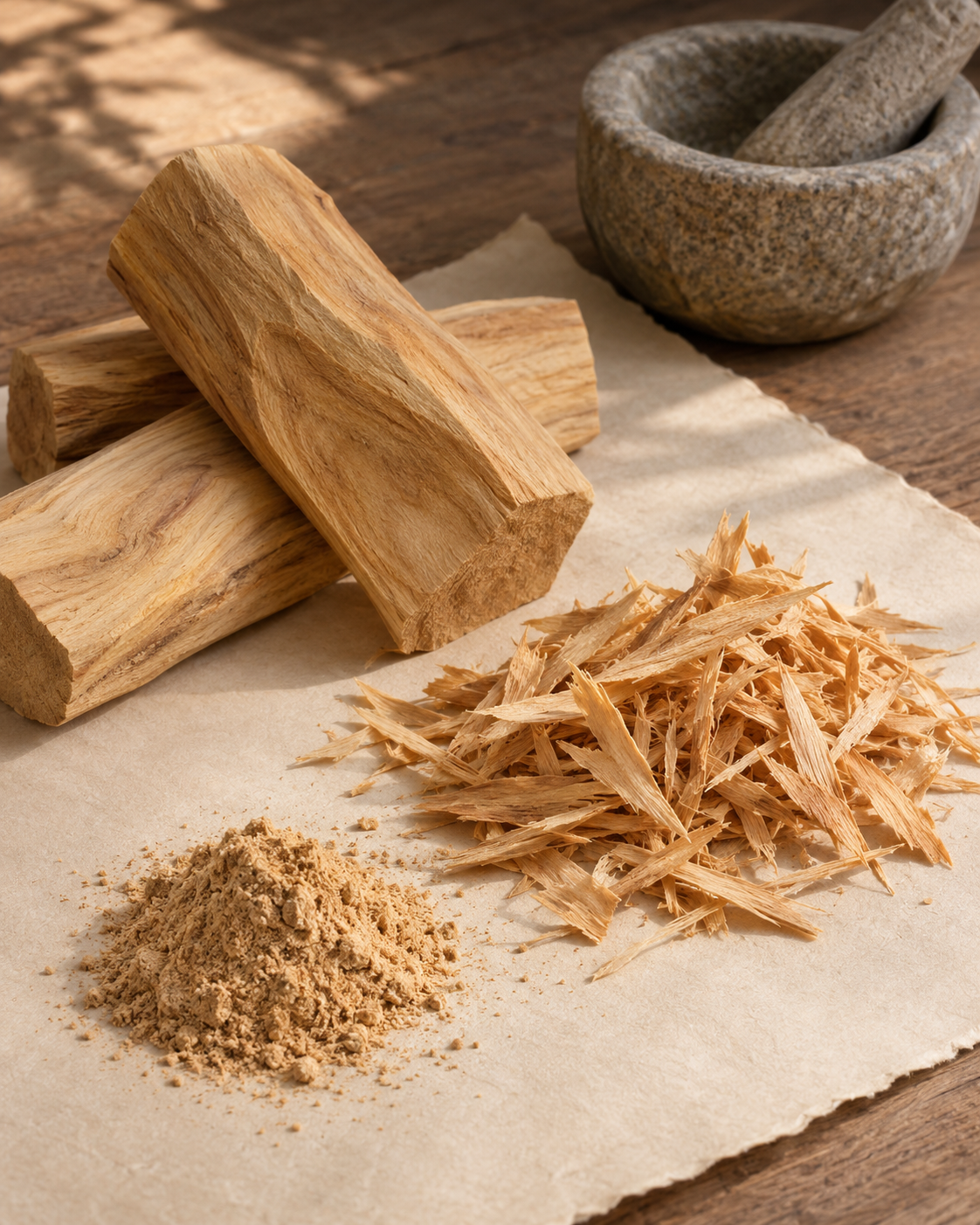
Sandalwood in Chinese and Indian Incense Traditions
Sandalwood is the aromatic heartwood of Santalum trees, used as powder, sticks, beads and carving material. Santalum album is not CITES-listed, but India applies product-form-specific export controls, so origin and documentation still matter. Chinese blended-incense practice often uses sandalwood inside a formula, while Indian traditions also use sandalwood on its own.
For anyone building a Chinese incense collection without a permit chain, sandalwood is the practical centre. It is widely available, it is not CITES-listed, its scent is stable, and it appears in classical formulas in every role from chief to guide.
What is sandalwood?
Sandalwood is the heartwood of trees in the genus Santalum, a group of root-parasitic trees native to India, Indonesia, Australia and the Pacific. The aromatic oil accumulates in the heartwood over the life of the tree — which is why mature trees are valuable and young ones are not, and why the material is farmed on long rotations.
Three species matter commercially:
| Species | Origin | Character | Notes |
|---|---|---|---|
| Santalum album | India (mainly Karnataka, Tamil Nadu), also Indonesia | The classic. Creamy, soft, long-lasting | Indian export policy varies by product form |
| Santalum spicatum | Australia (Western Australia) | Slightly sharper, drier, more woody | Widely available, planted on managed rotations |
| Santalum paniculatum / other Pacific species | Hawaii, Vanuatu, Fiji | Variable; some very fine | Smaller volumes, less standardised |
Terminology you will meet: 老山檀香 (lǎo shān tán xiāng), “old mountain sandalwood”, refers to mature Indian material of high oil content; 新山 (“new mountain”) refers to younger or non-Indian material. These are trade terms, not botanical ones — a seller’s “old mountain” claim should be treated as a claim, not a fact.
Is sandalwood CITES-listed?
No. Santalum album is not on the CITES appendices, which is the single biggest practical difference between sandalwood and agarwood.
But “not CITES” is not the same as “unrestricted”:
- India controls exports by product form. Current DGFT policy prohibits export of sandalwood in many raw forms, permits specified finished handicraft and machine-finished products, and classifies sandalwood oil as restricted and subject to authorisation.
- Some producing countries have their own harvest and export rules.
- Buyer-side law still applies — the US Lacey Act, for instance, makes it an offence to import plant material taken or traded contrary to local law.
For a compliant supply chain, ask: which species, which country, what product form, and is the local paperwork in order? The answer cannot be inferred from the absence of a CITES listing.
How do Chinese and Indian traditions use sandalwood differently?
| Chinese practice (合香) | Indian practice | |
|---|---|---|
| Unit | An ingredient inside a formula | A material in its own right |
| Typical use | Powder in blends; often the 使 (guide) or 臣 (deputy) role | Paste (chandan) for marking, powder for ritual, oil for perfumery |
| Sticks | One component of a blended stick | Also sold as single-material sticks |
| Carving | Beads, plaques, small objects | Beads, boxes, figures |
| Emphasis | Structure and balance of the whole | Purity and origin of the material |
Neither approach is more sophisticated. Chinese practice asks “what does this material do to the blend”; Indian practice asks “what is this material”. That is the same distinction that separates Chinese from Japanese incense — composition versus material.
What does sandalwood smell like?
Consistently described as creamy, soft, woody and slightly sweet, with a milky or buttery middle and a dry finish. It is one of the least volatile incense materials: a sandalwood stick or bead holds its scent longer than almost anything else used in blends.
Two practical consequences:
- It is a base, not a top. In a blend, sandalwood anchors. It rarely dominates the opening.
- It improves with slow heat. Scorched sandalwood smells flat and slightly sour; warmed sandalwood is rounder.
How can you tell real sandalwood from scented wood?
| Check | Real sandalwood | Scented or fake |
|---|---|---|
| Weight | Dense, heavy for its size; high-oil material sinks | Light |
| Cut surface | Uniform fine grain, pale yellow-brown to reddish-brown | Painted or oil-darkened surface over pale interior |
| Smell unheated | Soft, close, low | Strong and sharp — often fragrance oil |
| Smell when warmed | Develops over minutes, layered | Flat, immediate, then gone |
| Powder | Oily to the touch, clumps slightly | Dry, dusty, pale |
| Price | Indian album is expensive per gram | Too cheap for the claim |
The most common fake is not fake wood — it is real, low-oil wood soaked in sandalwood oil or synthetic fragrance. It smells right for a week and then stops.
How is sandalwood used in incense?
- Powder in a blended formula — the most common use in Chinese incense. Ground fine, sifted, blended by role.
- Sticks — either single-material or as the base of a blend. Sandalwood sticks burn steadily and hold their scent.
- Chips, warmed — on a mica plate or an electric warmer, the closest to how the material is best judged.
- Beads — carved or turned, worn; the same material in wearable form.
- Carving — boxes, figures, handles; a craft tradition in its own right.
In our own work, sandalwood appears in most of the blended bead formulas: it is the material that gives the blend a base to sit on, and it is the reason we can build a Chinese formula without agarwood.
How should sandalwood be stored?
- Dry, sealed, out of sunlight. Oil oxidises; light accelerates it.
- Away from strong smells. Sandalwood absorbs odours from its surroundings.
- Do not refrigerate. Condensation on the surface dulls the scent.
- Powder keeps less well than solid. Use powder within a year or two; chips and beads keep far longer.
Frequently asked questions
Is sandalwood the same as agarwood? No. Agarwood is resin formed in Aquilaria after injury, is CITES-listed, and is far more expensive. Sandalwood is the heartwood of Santalum, is not CITES-listed, and is the practical base material for most blends.
Is Indian sandalwood illegal to buy? There is no single worldwide answer. Legality depends on origin, product form, lawful harvest and export, and the destination’s import rules. Ask the seller for documentation that matches the exact material offered.
Does sandalwood have health benefits? We do not make health claims about incense materials. This page describes material, craft and trade. Claims about therapeutic effects have their own regulatory requirements, and we do not make them.
Why does my sandalwood bead stop smelling? The surface oil is exhausted and the wood has dried. Warmth and humidity change how much is released; a bead worn daily will read stronger than one sitting in a drawer. It is not “dead” — it is just slow.
Which is better, Indian or Australian sandalwood? Different, not better. Indian album is creamier and more expensive; Australian spicatum is drier and more available. For blending, both work; for a single-material statement, the difference is personal.
Explore further
- Agarwood: what it is and why CITES matters
- Chinese incense: what it is and how it’s made
- How to burn incense sticks, step by step
Blended incense in wearable form — every piece lists its formula, including which materials are used as the base. → Scented Jewelry
Trade reference: Directorate General of Foreign Trade, India — current sandalwood export policy notification.