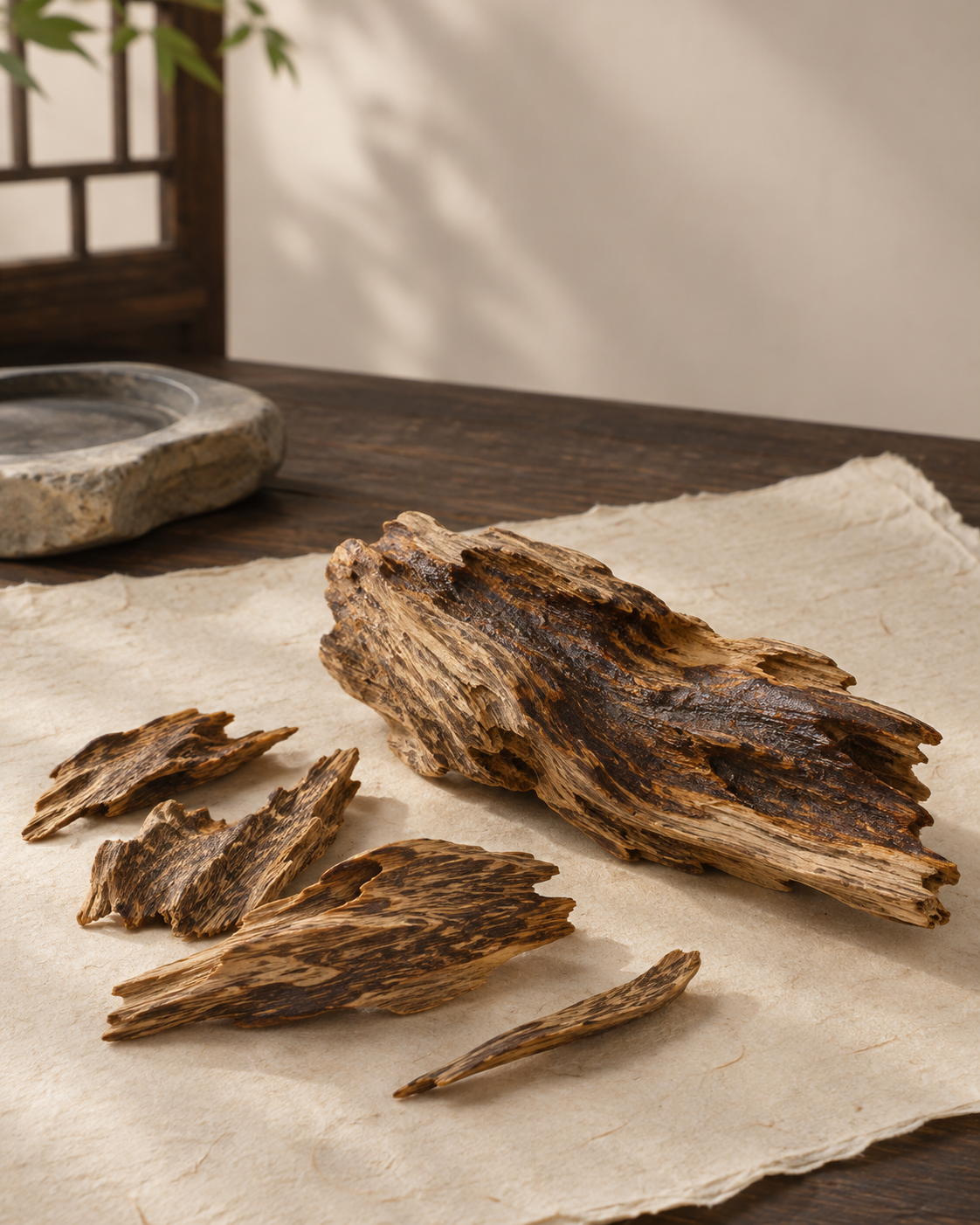
Agarwood: What It Is, Why It Costs What It Costs, and Why CITES Matters
Agarwood is not a species of tree — it is a condition. When an Aquilaria or Gyrinops tree is injured and infected, it produces a dark, resin-rich heartwood as a response, and that wood is agarwood. Healthy wood from the same tree is pale, light and nearly odourless.
All Aquilaria and Gyrinops species are listed in CITES Appendix II, and the annotation that governs them turns on the form of the material rather than the species: finished retail products and exhausted powder are exempt, while beads, prayer beads and carvings are not. That sentence is the one most sellers leave out, and it is the one that matters most if you are buying from abroad. This page covers what the material is, why it is priced as it is, and what the paperwork actually requires.
What is agarwood?
The genus Aquilaria (and the closely related Gyrinops) grows across South and Southeast Asia — India, Bangladesh, Myanmar, Thailand, Laos, Vietnam, Cambodia, Malaysia, Indonesia. In its healthy state the wood is pale, soft and low in oil.
Agarwood forms when the tree is wounded — by weather, by insects, by boring fungi entering the wound — and responds by producing resin at the site of injury. Over years, the resin saturates the surrounding wood, turning it dark, dense and aromatic. The process is not fully understood, which is part of why cultivation has been difficult: you can plant the tree, but you cannot simply order it to make resin.
Three consequences follow:
- Most of the tree is not agarwood. A plantation tree may yield usable resinous wood from a fraction of its mass.
- Grade is about resin, not age. A young tree with a good infection can out-grade an old tree without one.
- The name is not a guarantee. “Agarwood” describes a condition, so the same word covers material worth dollars per gram and material worth very little.
Oudh / oud is the Arabic name for the same material, and it is the term most used in perfumery. 沉香 (chén xiāng) is the Chinese name. Kyara / kynam refers to the highest traditional grade in the Japanese and Chinese grading systems.
Why is agarwood so expensive?
Four reasons, and none of them is marketing:
- Low yield. Only a small proportion of a tree’s mass becomes resinous, and only a proportion of trees become infected at all.
- Time. Plantation trees typically need years before they can be inoculated and years more before harvest. Wild material that formed naturally may have taken decades.
- Grading spread. The difference between a low grade and a high grade is not incremental — it is orders of magnitude. Top-grade material is sold by the gram, sometimes against gold.
- Restricted supply. Permits and traceability requirements — not just demand — govern how much legal material reaches an export market.
This is also why the market attracts fraud: oil-soaked wood, dyed wood, resin-injected wood, and material described as a grade it is not.
What does agarwood smell like?
Descriptions vary by grade, origin and how it is heated, but the vocabulary that recurs is: resinous, woody, warm, slightly sweet, with a balsamic depth and, at higher grades, a faint floral or fruity note. Lower grades read woodier and thinner; the top grades are described as complex and slow-changing.
Two practical notes:
- Agarwood should be warmed, not burned. Like all resins, direct flame scorches it. See how to burn resin incense.
- Scent at room temperature is not a reliable test. A piece sold as high-grade that smells strongly through a bag is often oil-treated. Genuine high-grade wood is comparatively quiet until heated.
Is agarwood legal to buy and ship?
All Aquilaria and Gyrinops species are listed in CITES Appendix II — including plantation-grown material. But “listed” does not mean “every article needs a permit”. The listing carries Annotation #14, written specifically for agarwood, and what it regulates is the form of the material, not the species alone.
| Exempt under Annotation #14 | Still controlled |
|---|---|
| Seeds and pollen; fruits and leaves | Wood chips |
| Seedlings and tissue cultures (in vitro) | Powder that has not been oil-extracted |
| Exhausted agarwood powder — including compressed powder in any shape | Bulk oil and resin; other non-exempt derivatives |
| Finished products packaged and ready for retail sale | Beads, prayer beads and carvings |
Two definitions decide most real cases. Exhausted powder is what remains after the fragrant oil has been drawn off. Compressed powder is wood powder pressed into a shape and held by a chemical or natural binder — which is how a pressed incense bead is made.
Where classification requires authority input. A pressed bead made from several mixed botanical powders may be described both as compressed powder and as a bead. Annotation #14 exempts exhausted agarwood powder, including compressed powder in all shapes, while wood chips, beads, prayer beads and carvings are excluded from the finished-retail-product exemption. Do not resolve that overlap from marketing language. Give the management authority the formula, material form, manufacturing method, product photographs and destination, and ask for a written determination.
What that looks like in practice:
| Situation | Realistic position |
|---|---|
| Agarwood bought and used inside one country | Domestic law only; no CITES permit for movement |
| Wood chips, beads, prayer beads or carvings crossing a border | These are expressly excluded from the finished-retail exemption; confirm the required CITES documents before shipment |
| Agarwood oil crossing a border | Bulk oil remains controlled; a finished product packaged and ready for retail sale may fall within the retail exemption. Confirm the exact presentation with the authorities |
| A composite pressed incense product where agarwood is one powder among several | Classification depends on the facts supplied to the authorities; confirm before shipping |
| Sending a sample | The same question as the shipment it precedes. A sample is not a way to test the rule |
| Qualifying personal or household effects carried by a traveller | The CITES quantity limits include up to 1 kg of chips, 24 ml of oil and two sets of beads or prayer beads (or two necklaces or bracelets) per person. This is not a commercial-shipment exemption |
Buyer-side law runs in parallel. In the United States, the Lacey Act can apply to plant material taken or traded contrary to source-country law, and a plant import declaration may apply depending on the product and tariff classification. In the EU, the Wildlife Trade Regulations implement CITES with additional controls; the UK applies its own wildlife-trade regime. Export-side guidance is important, but the importer should still confirm the destination-side route.
Our current position (7 November 2026). The relevant Chinese local authority has given an initial positive oral view that QINGYUN’s current products do not require a certificate. Germany’s BfN has replied that the Chinese export authority’s determination is the starting point for the export side. Substantive responses from the United Kingdom, Canada and the United States remain pending. We therefore describe this as an active consultation result, not a blanket exemption. Before shipment, we match the exact formula and product form to the destination and retain the authority correspondence. Any agreed material substitution is stated in the quotation and product information; it is never made silently.
Read the annotation itself rather than a summary of it, and check with your national management authority. And do not accept “it is plantation, so it is fine” — plantation material is listed, and the exemption turns on form, not origin.
How is agarwood graded?
Traditional grading is a craft vocabulary, not a standard, and it varies by country. The concepts that recur:
| Concept | What it means |
|---|---|
| Sinking grade | Resin-rich enough to sink in water. The classic, coarse test |
| Half-sinking | Suspends or sinks slowly |
| Non-sinking | Floats; lower resin content |
| Kyara / kynam | Top traditional grade — very high resin, complex scent, sold by the gram |
| Origin names | Vietnamese, Cambodian, Malaysian, Indonesian, Indian — each with its own reputation and price |
| Colour | Darker generally indicates more resin, but colour can be induced |
Two cautions: a water test damages nothing but proves only density; and colour can be faked by soaking or dyeing. There is no substitute for a trusted supply chain.
How is agarwood used in Chinese incense?
Three ways:
- As a warming material — small chips on a mica plate or an electric warmer, the closest thing to how the material is best appreciated.
- As powder in a blend — in 合香 (He Xiang), agarwood can occupy the chief role, or a supporting role where a small amount adds depth.
- As an oil — distilled, and used in perfumery far more than in incense.
In classical formulation the material is placed by role rather than by price: a small amount of agarwood as 使 (guide) can do more for a blend than a large amount used without structure. → What the four roles mean
Agarwood vs sandalwood — the practical difference
| Agarwood | Sandalwood | |
|---|---|---|
| Source | Resin formed in Aquilaria / Gyrinops after injury | Heartwood of Santalum species |
| What makes it valuable | Resin content, formed over years | Oil content in the heartwood; the tree must age |
| CITES status | Appendix II — all species | Not CITES-listed (Santalum album has Indian export restrictions instead) |
| Scent character | Deep, resinous, complex, changes with heat | Creamy, woody, soft, relatively stable |
| Price | Very high, by the gram at top grades | Moderate, by weight |
| Typical use | Warming, high-end blends | Blends, sticks, beads, carving |
For most buyers, sandalwood delivers a Chinese-incense experience without a permit chain. → Sandalwood in Chinese and Indian traditions
What should you check before buying agarwood?
- Species name in Latin — Aquilaria which species, and from where. If a seller cannot name it, stop.
- CITES position — check the exact article form against Annotation #14 and obtain the relevant authority’s determination where the classification is not clear.
- Origin claim in writing — country, and whether wild or plantation.
- Weight and dimensions — price per gram is the only comparable unit at the top end.
- Return policy — for a material this fraud-prone, no returns is a red flag.
Frequently asked questions
Is agarwood the same as oud? Yes. Oud / oudh is the Arabic name; 沉香 is the Chinese name; agarwood is the English one. The material is the same.
Is plantation agarwood legal to export? Plantation material is listed exactly like wild material, so “planted” does not mean “exempt”. But the listing exempts a set of forms, not a set of origins: under Annotation #14, sealed retail products and exhausted powder are out of scope, while wood chips, beads, prayer beads and carvings stay in.
Can agarwood be shipped as a gift or a sample? A sample is treated as a shipment in whatever form it takes, so the same form question applies — a chip does not become exempt by being small. The only quantity exemption on the books is for personal effects carried by a traveller: up to 1 kg of chips, 24 ml of oil and two sets of beads per person. It does not cover commercial shipments.
Why is some agarwood so much cheaper? Usually because it is a lower grade, a different species sold under the same name, or treated wood (oil-soaked, dyed, injected). Price per gram at the top end is not a marketing device; it reflects resin content.
Does agarwood have health benefits? We do not make health claims about any incense material. This page describes material, craft and regulation. Claims about therapeutic effects are a separate matter with separate regulatory requirements, and we do not make them.
Explore further
- Sandalwood in Chinese and Indian traditions
- Chinese incense: what it is and how it’s made
- How to burn resin incense without scorching it
What we do make — blended incense beads and sticks, with the full formula and material list on each product page. A formula that contains agarwood goes through the confirmation above before we quote it. → Scented Jewelry · Incense
Official reference: CITES CoP19 information document, including the history and text of Annotation #14.