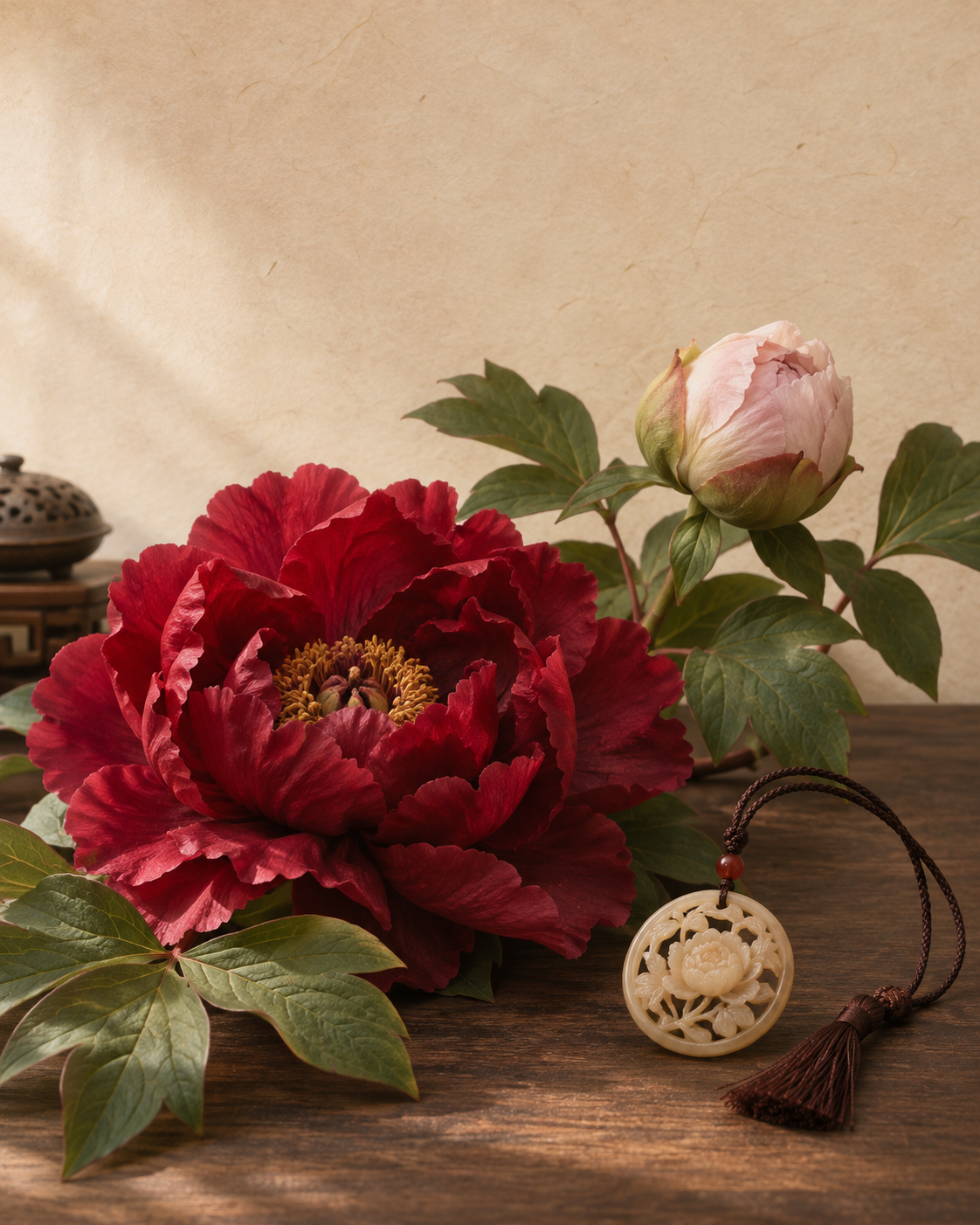
Peony Symbolism in Chinese Culture: The Flower Called King
The peony (牡丹, mǔdān) is the Chinese emblem of prosperity and honour, and is called 花中之王 — king of flowers. The reading is not primarily about money: 富貴 (fùguì) means wealth and rank, the condition of having arrived. It is the flower of having enough.
It is also the most political flower in Chinese art. Peonies appear on Tang court silks, on Song ceramics, in Ming painting and on Qing imperial porcelain, and in every period they carry the same claim: this is what flourishing looks like.
What does the peony symbolise?
| Meaning | Where it comes from |
|---|---|
| Prosperity and honour (富貴) | The dominant reading, from the Tang onward |
| Rank and status | Associated with court and with the examination elite |
| Feminine beauty | Conventional pairing in painting and poetry |
| Spring, and the peak of the season | It blooms late — after the first flush of spring |
| Resilience | The legend of its banishment from Chang’an (see below) |
The word 富貴 is often translated as “wealth”, which flattens it. 富 is material sufficiency; 貴 is standing. The pair is closer to “prosperous and honoured” — a social condition, not a bank balance.
Why is Luoyang the city of peonies?
A later legend says that Empress Wu Zetian ordered all flowers to bloom in winter. The peony refused and was banished from the capital, then flourished in Luoyang. This is a cultural story, not established evidence for how peony cultivation began there.
The story presents the peony as the flower that would not be commanded. The documented point is that Luoyang has a long peony-cultivation tradition, flourishing particularly from the Tang and Song periods, and remains strongly identified with the flower today.
What is the difference between 牡丹 and 芍药?
Both are called “peony” in English, and both are in the genus Paeonia. In Chinese they are distinct:
- 牡丹 (mǔdān) — tree peony, woody stems that persist through winter, the flower of the motif
- 芍药 (sháoyào) — herbaceous peony, dies back each year, also cultivated and also painted
The tree peony is the one that carries the imperial and symbolic weight. When a Chinese design says 牡丹, it means the woody one.
Where does the peony appear?
- Textiles — Tang brocades; the peony roundel is one of the most reproduced patterns in Chinese silk
- Porcelain — blue-and-white and famille-rose wares, often with phoenix or rock
- Painting — bird-and-flower painting, where peony plus pheasant is a standard prosperity pairing
- Architecture and carving — stone, wood and lacquer
- Garden — the peony is a garden subject in its own right, not a wildflower
- Rebus combinations — peony with magnolia and crabapple completes 玉堂富贵
That last point matters: as with most Chinese motifs, the peony is usually read in combination. Alone it says prosperity; beside a pheasant it says rank; with magnolia it completes a phrase.
How does the peony motif work at bead scale?
The peony is the hardest common motif to reduce, because its identity is in the density of its petals. Three reductions are used:
- Rosette — concentric rings of petals around a centre; reads as peony at 8–10 mm
- Half-bloom — a single side view, more legible in relief but less recognisable
- Petal field — a repeating pattern of overlapping petals, used where the object is larger
At bead scale the rosette wins: it keeps the flower’s density without needing detail. It also survives wear, because the centre is the highest point and the petals fall away from it.
What the peony does not mean
- It is not a good-luck charm. 富貴 is a description of a condition, not a mechanism. We describe the motif; we do not claim that wearing it produces prosperity.
- It is not the national flower — China has no officially designated national flower, despite repeated proposals.
- It is not exclusively imperial. Peonies were cultivated, painted and worn well beyond the court, and the motif’s popularity is popular, not royal.
Frequently asked questions
What does the peony symbolize in Chinese culture? Prosperity and honour (富貴) — wealth together with rank. It is called the king of flowers (花中之王).
Why is the peony called the king of flowers? It is the largest and most elaborate of the traditional cultivated flowers, and the one most associated with court and elite display. The title is conventional, not botanical.
What is the difference between a tree peony and an herbaceous peony? The tree peony (牡丹) has woody stems that persist through winter; the herbaceous peony (芍药) dies back each year. The 牡丹 is the one in the symbolism.
Is the peony China’s national flower? No. China has not officially designated a national flower, though the peony is frequently proposed and widely assumed to be one.
Can peony motifs be used in jewellery? They are, commonly — usually as a rosette or a half-bloom. At small scale the flower is read by silhouette rather than by detail.
Explore further
Motif collection — pieces grouped by motif, each with its design note and dimensions. → Motif collection
Background reference: The State Council Information Office of China, “Peonies in Luoyang”.